It looks like I’ve caught a really bad case of T/C Catalog Disease (TCCD). The primary
vectors of the disease are Gunbroker.com and eBay. Stay away, avoid these places so
that you may remain disease-free. It’s too late for me.
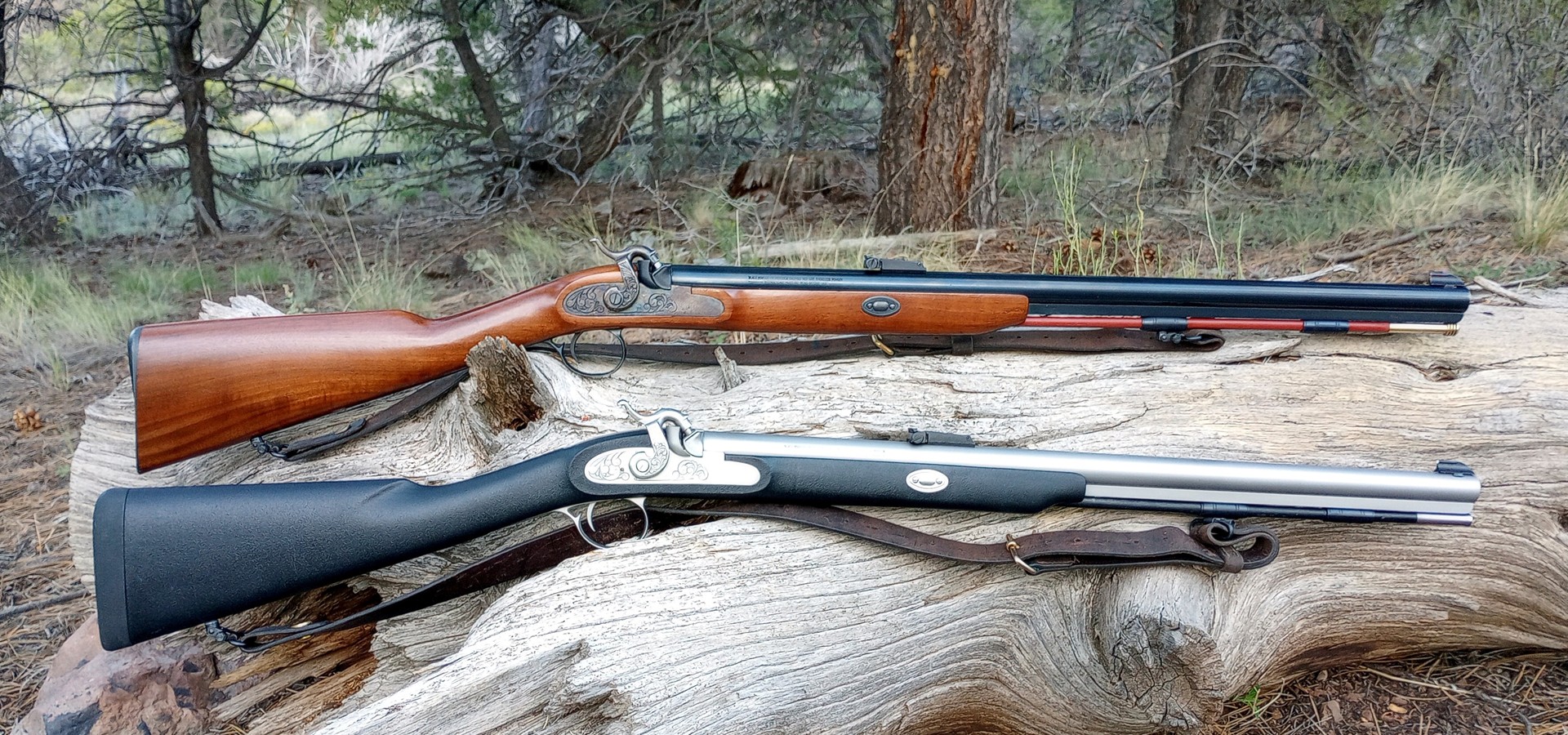
It started for me last year when I got re-infected with Muzzleloader Fever after 30 years or so. I hopped on to Gunbroker and found a
Thompson/Center New Englander caplock muzzleloader. This is a muzzleloader very similar
to the T/C Grey Hawk that I owned back in the mid-1990’s. Not too long after buying the
New Englander, I spotted a Grey Hawk on
Gunbroker, and soon it too arrived on my doorstep.
It was a lot of fun re-familiarizing myself with shooting traditional muzzleloaders.
I messed around with patched round balls and with saboted pistol bullets (.44 cal.
Hornady XTPs) sighting them in, determining accuracy and realistic range. I decided
to apply for a H.A.M. hunt for the 2025 spring javelina season so that I could pursue
the wily little desert pigs with a muzzleloader once again.
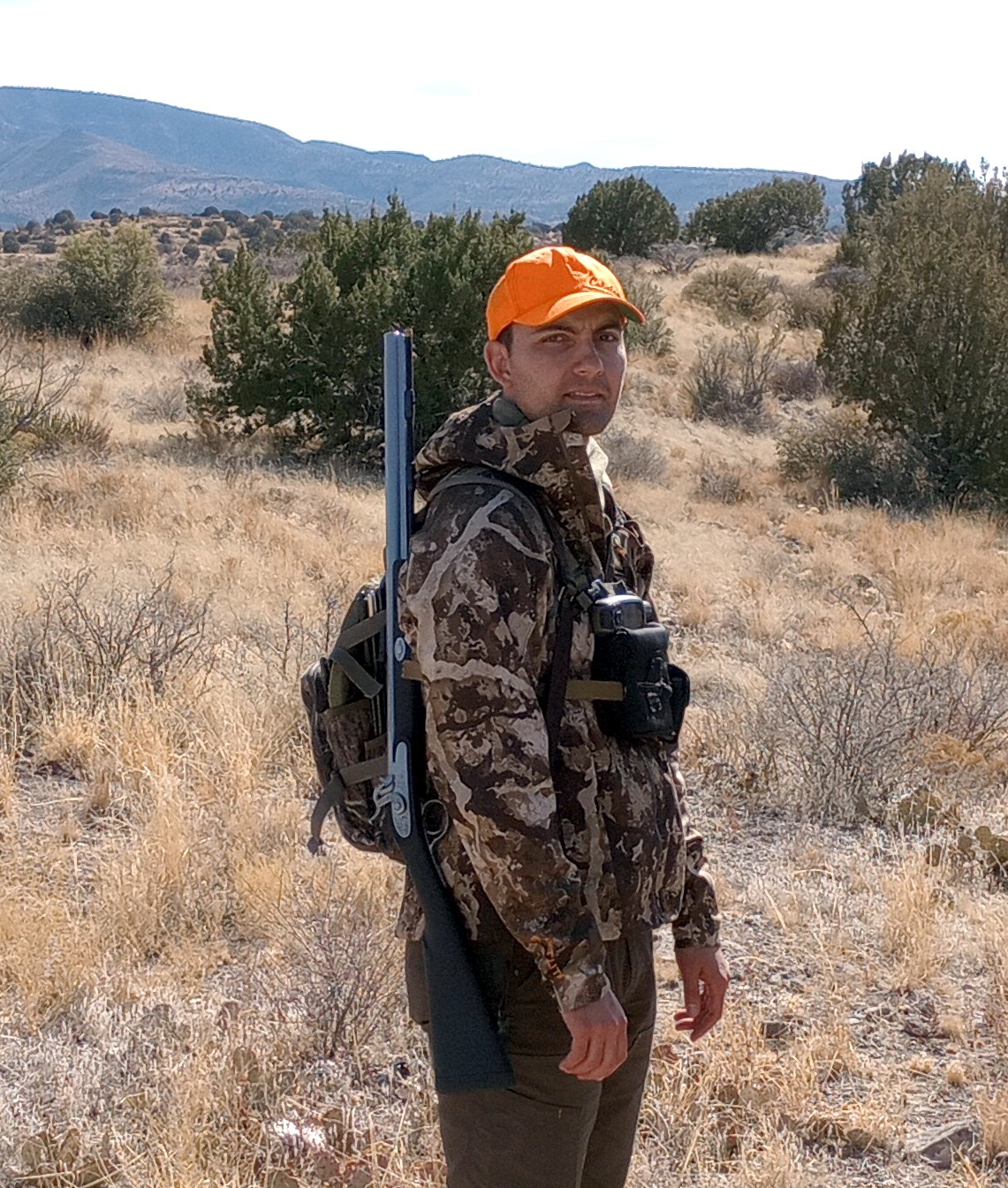
Sam on the 2025 javelina hunt with the Grey Hawk
|
Both sons, Ben and Sam, were on the application with me and we were drawn for the hunt.
Sam flew out from his current residence in North Carolina and hunted with the Grey Hawk.
I hunted with the New Englander, and Ben hunted with his 6” barreled Taurus Tracker in
.357 mag. I would have liked Ben to have had the opportunity to hunt with a black powder
rifle, but I only had two. Maybe you see where this is going … The conditions on our
hunt were really dry, and we never saw any pigs. Maybe next year.
Around the time that I acquired these two classic T/C muzzleloaders, I decided to rummage
through my stash of old gun catalogs. I was pretty sure that I had a couple of old T/C
catalogs that featured these rifles, and I wanted to review what T/C had to say about
them at the time. I found that I had the 1995 and 1996 catalogs, numbers 22 and 23. My
records say that I acquired my original Grey Hawk sometime during the first quarter of
1995.
The 1995 catalog showed that T/C offered 15 or so different sidelock models and 5 inline
ignition models. This is by my own imperfect count. I say that it is imperfect,
because some models I separated by wood vs. plastic stocks, and some I didn’t. I didn’t
capture all the sub-variants, like blued vs. stainless. The early to mid-90’s was the
high-point for the sheer number of T/C muzzleloader models and sub-variations that were
offered. If I would have broken down my tabulation with calibers offered across the
models, my accounting would have grown even more complex.
To give you a taste of how many traditional sidelock muzzleloaders T/C offered just in
1995, here is the list:
- Hawken (caplock and flintlock)
- two Hawken special editions
(it was the 25th anniversary of the introduction of the T/C Hawken)
- Renegade (caplock and flintlock)
- Renegade Hunter (caplock single trigger)
- Big Boar (.58 cal.)
- New Englander (26" barrel, walnut stock)
- New Englander Rynite (24" barrel, plastic stock)
- Pennsylvania Hunter (31" barrel, caplock and flintlock)
- Pennsylvania Hunter Carbine (21" barrel, caplock and flintlock)
- White Mountain Carbine
- and the Grey Hawk
Inline ignition models that were offered in 1995 include: the Scout Carbine (21"),
the Scout Rifle (24"), Thunder Hawk Carbine (21"), Thunder Hawk Rifle (24"), and the
Fire Hawk.
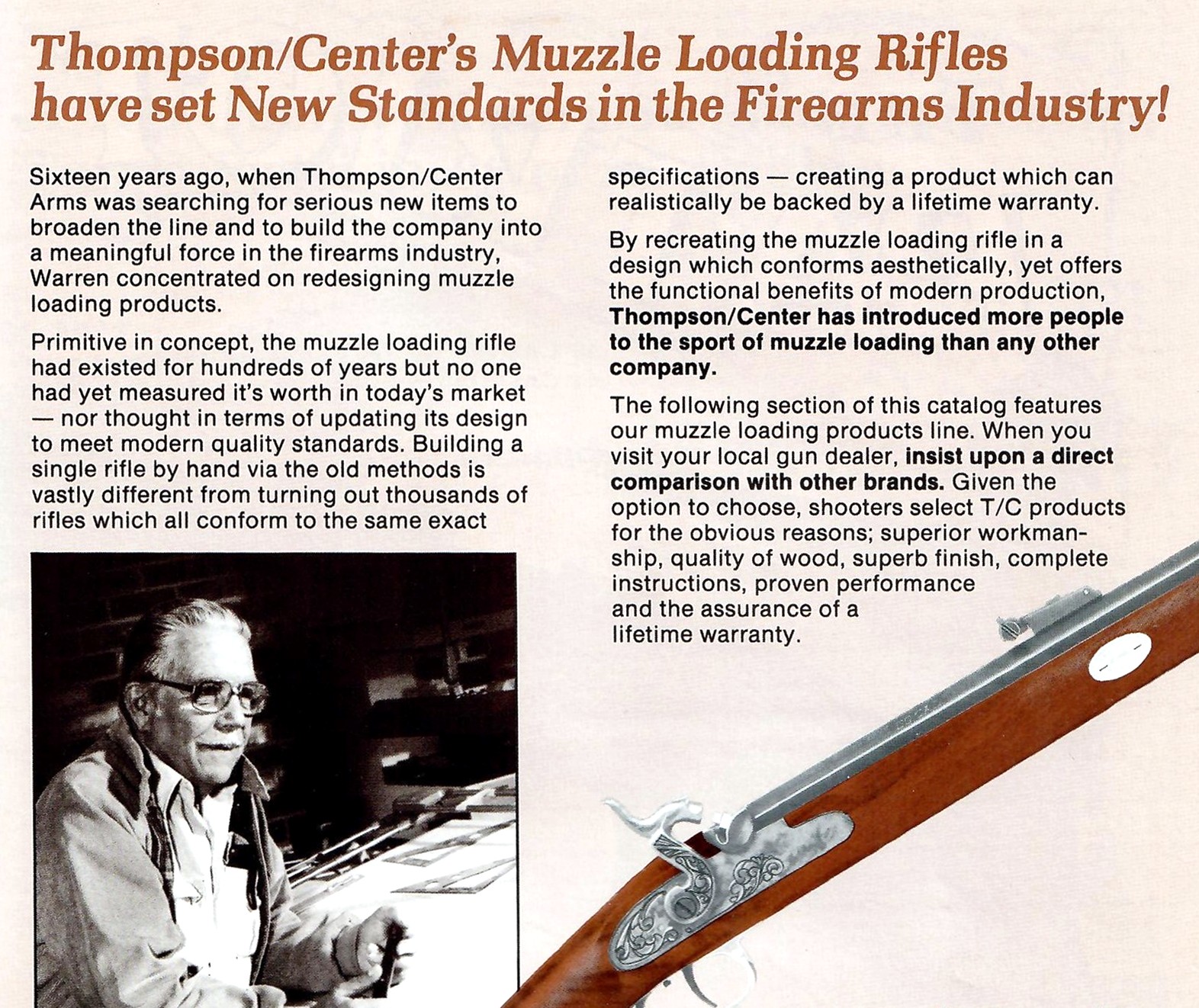
From T/C Catalog No. 13, 1986
|
After deep-diving and absorbing all the muzzleloader info in these two catalogs, I was
thirsty for more. When were the various models introduced? When were they dropped
from the catalog? What changes were made to existing models over the years?
I started haunting eBay looking for more catalogs. I started by expanding from the two
catalogs that I already had, going forward and backward year-by-year. At this point I
have gathered the T/C catalogs from 1982 (catalog #9) to 2001 (catalog #28). I can find
listings for earlier ones (which I have not yet purchased), but it’s been harder to find
catalogs from the early 2000’s, surprisingly.
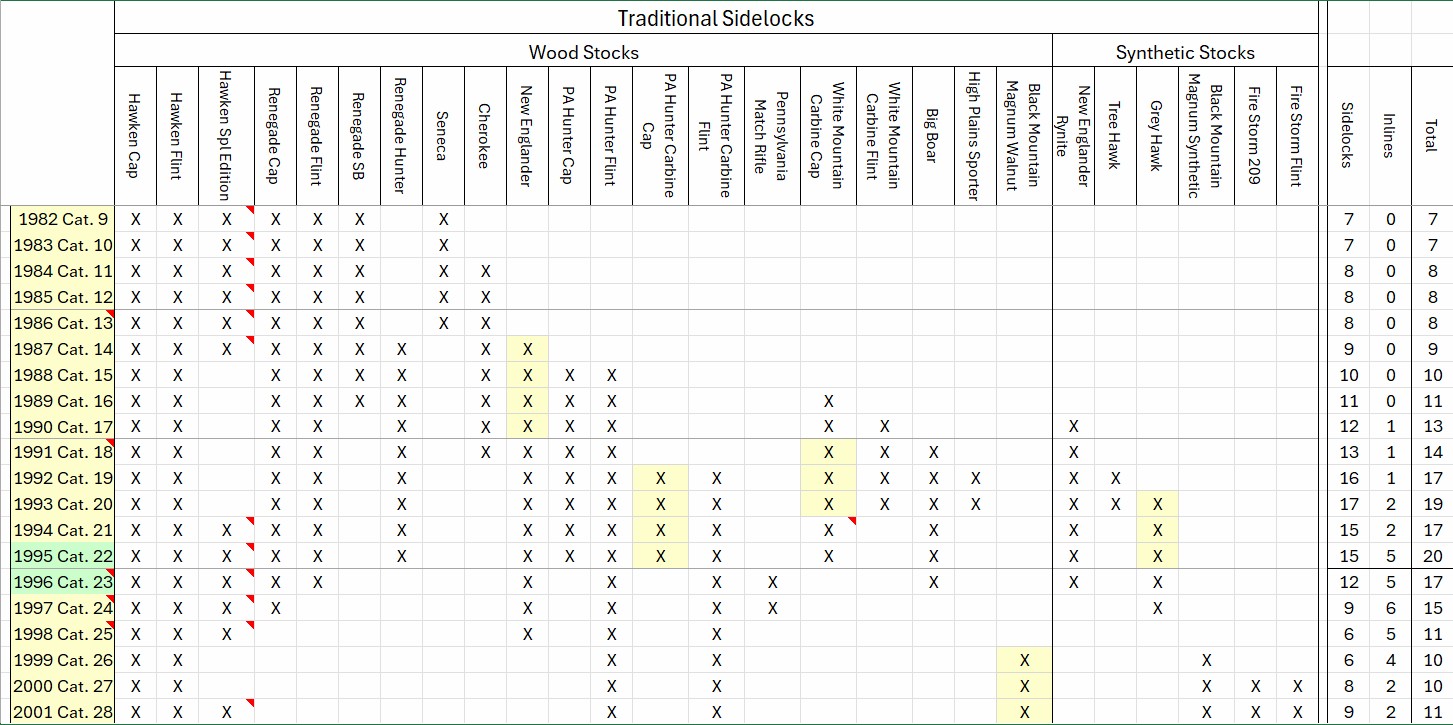
With this collection of catalogs, I’ve been able to put together a spreadsheet that
details when the various models were introduced, and when they were dropped from the
catalogs, at least for the years that I have catalogs for. This begins to tell an
interesting story, but it also reveals the depths of my TCCD illness.
You’ve probably guessed by now, that my TCCD has not been limited just to accumulating
catalogs. Note below, the yellow highlighted Xs. Those are the possible years of
manufacture of the T/C muzzleloaders that I now own. I am now up to eight T/C
muzzleloaders (sheesh!). The Martinez boys won’t have any problem picking out just
three from the collection to hunt javelina with in 2026.
But let’s get back to the spreadsheet. This section of my spreadsheet details only the
traditional sidelocks. For now I've left off the inline models (a few of which I have
picked up). Notice the horizontal lines and the little red triangles. The triangles
are cell notes. The horizontal lines represent feature breakpoints which can help to
pin-down a particular rifle’s year of manufacture.
First notice the line between 1985 and 1986. Before ’86, rifles were not marked on the
barrel with the model name, such as Hawken, or Renegade. They also were not marked with
the “Black Powder Only” warning. I have not verified this personally, not having
observed that many early rifles. I’m relying on information gleaned from reading the
posts of experts on the muzzleloading forums.
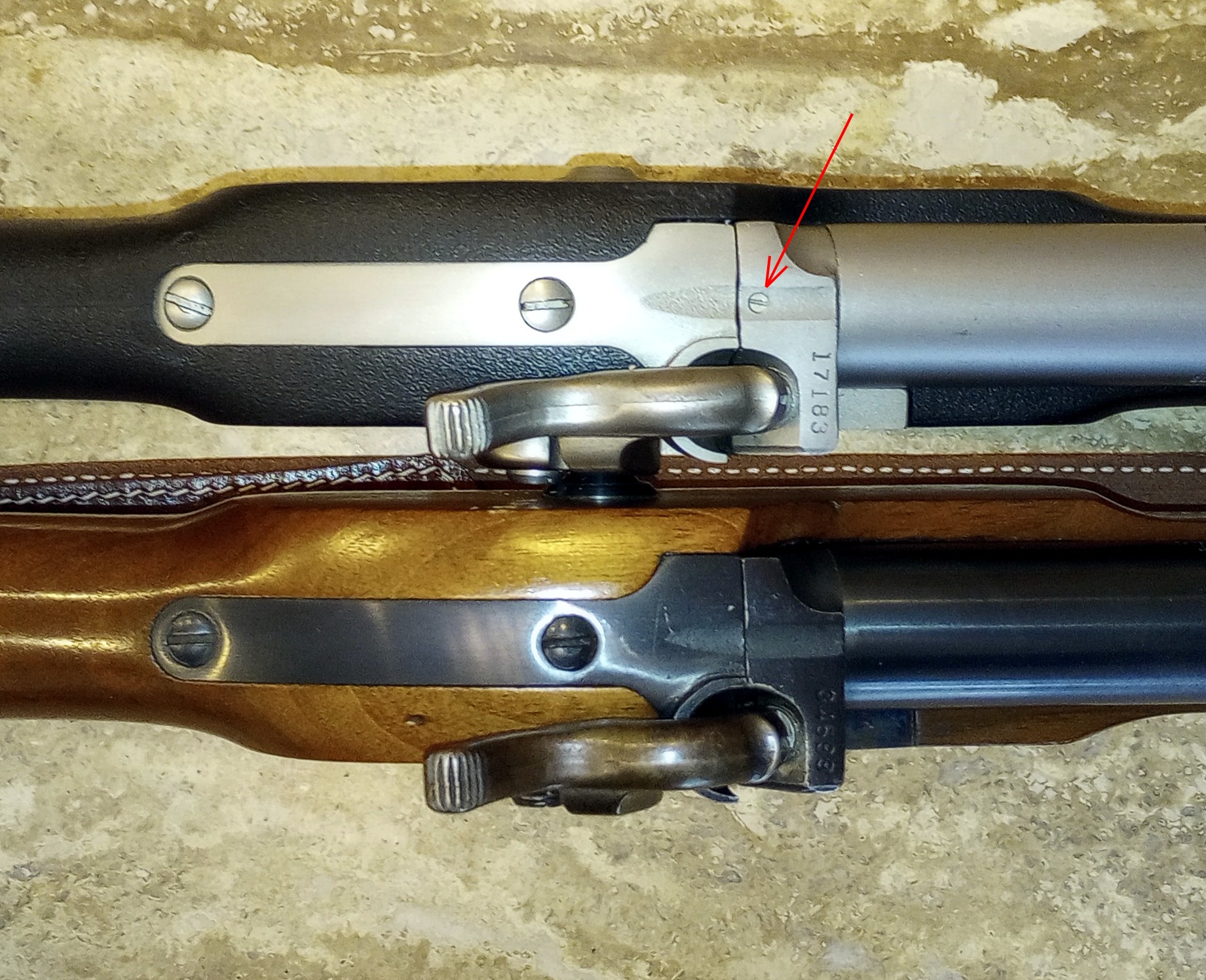
Presence and absence of the breech block screw hole:
Grey Hawk, top; New Englander, bottom.
|
There is another horizontal line between 1990 and 1991. Starting in 1991, T/C started
drilling and tapping a threaded hole on top of the breech block of the sidelock rifles.
This allowed the installation of scope bases that spanned from the rear sight screw holes
to the breech. I picked up an aftermarket scope base that verifies this for me. The
instruction for the base explicitly states that rifles earlier than ’91 will need a
gunsmith to add this #6-32 breech block screw hole.
Finally, in 1996, T/C added the QLA feature to all their muzzleloader barrels. QLA stands
for “Quick Load Accurizor” (yes, that's how they spell it). The rifling of the last,
approximately 1-inch at the end of the muzzle, has been removed. The bore at the end of
the muzzle is basically groove diameter all the way around – no lands. This is to allow
easier starting of a projectile down the muzzle. That’s great unless you are using
full-bore diameter lead conicals. Many shooters have reported poor accuracy with lead
conicals in a QLA barrel. They believe that gases can leak past the sides of such a
bullet in the QLA section of the barrel, tipping the bullet as it exits the barrel.
Bullets with expanding plastic skirts such as sabots or Powerbelts seem to do fine with
QLA.
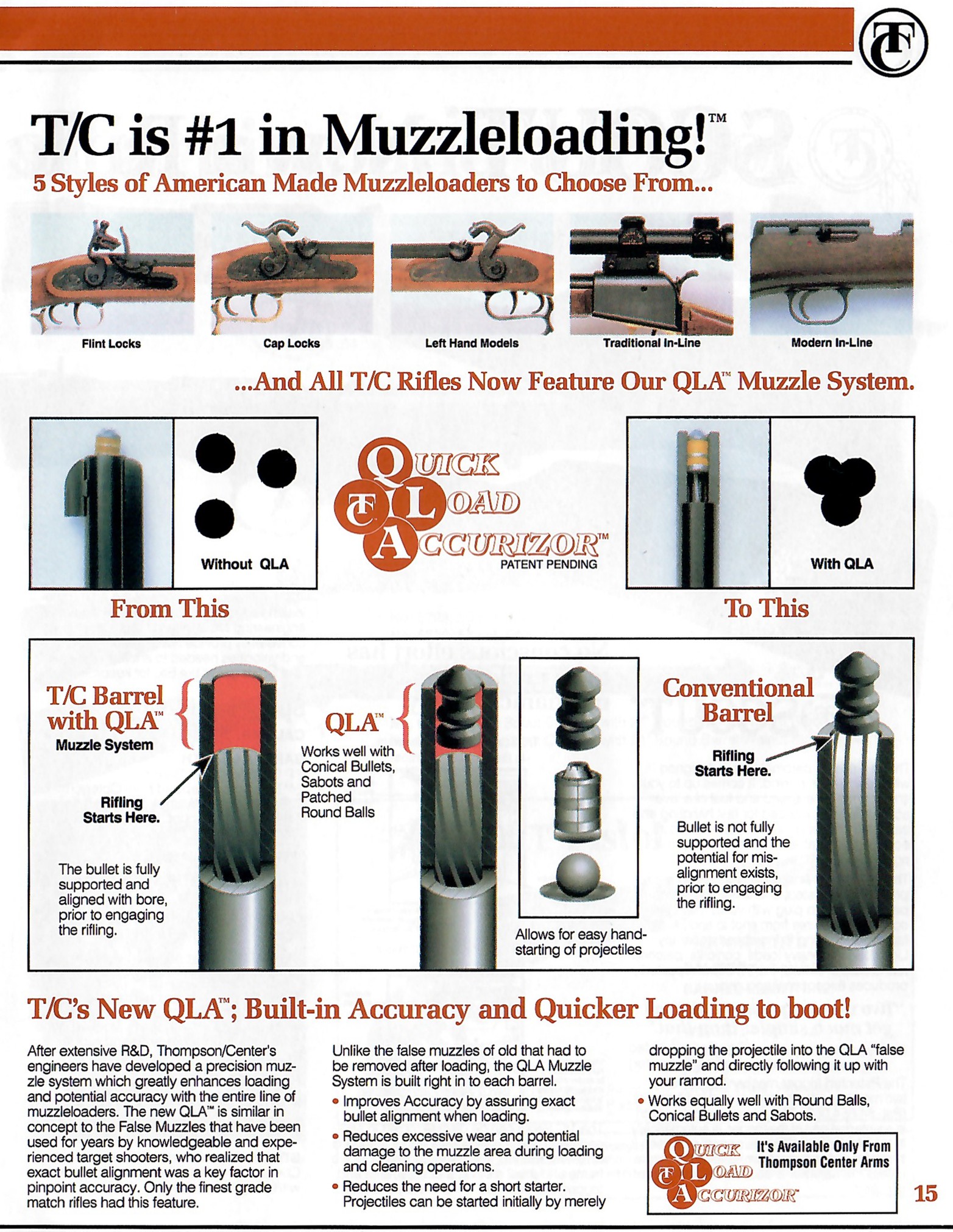
T/C Catalog No. 23, 1996, Page 15
|
Anyway, the presence or absence of these various features can help identify the approximate
year of manufacture of your vintage T/C muzzleloader. On March 27th of 1997, T/C had a
major factory fire. Most of their records were destroyed, so model/serial number lookup
has not been possible since then.
Last year about this time, I wrote two newsletter stories that discussed the New Englander
and the Grey Hawk. I don’t really mean to keep bringing them up, but I would like to point
out that the New Englander does not have the breech block screw hole, but the Grey Hawk does.
That means that my New Englander was made between 1987 (the first year of production) and
1990. My Grey Hawk was made between 1993 (first year of production) and 1995. It can’t be
newer than 1995 because it does not have a QLA barrel. See how this works?
Yup, vintage T/C muzzleloaders are My Current Thing. Sorry, but you can expect that my
next several newsletter stories will be on this subject.
I have been drawn for a Handgun, Archery, and Muzzleloader (H.A.M.) hunt for elk (!) in
November. The area for this hunt is just outside the towns of Springerville and Eagar in
eastern Arizona. My expectations are pretty low, first because this is a “Limited
Opportunity” hunt. Second, because half of my area just burned in May in the Greer Fire.
I’m hoping for good luck anyway.