Today, traditional sidelock muzzleloaders have become but a small facet of the overall
muzzleloader market. The sidelining of the sidelock began in 1985 when Tony Knight
introduced the MK-85 inline muzzleloader to the marketplace. With ergonomics quite
similar to a modern bolt action hunting rifle, the MK-85 and follow-up inline ignition
models by Knight and other manufacturers, in time relegated the traditional sidelock
muzzleloader to the old guys that stubbornly held on to the fixed opinion that a “real”
black powder rifle had to have a side-hammer, either flintlock or the newer-fangled
caplock. Nothing wrong with that. You feel history when you pick up a sidelock.
Thompson/Center was the first major gun-maker to bring a mass-produced muzzleloader to
the market in 1970, the famous T/C Hawken. They sought to expand the market, hence
their sales, by lobbying state game departments to institute special muzzleloader seasons.
They were quite successful in this endeavor, as just about every state game department
instituted special muzzleloader seasons.
Hunters across the nation picked up a muzzleloader (mostly T/Cs) so that they could hunt
in these special seasons. Many, perhaps most, did not get into black powder because of
any particular interest in historical arms. They simply wanted to have more
opportunities to hunt.
So when a better mousetrap came along, in the form of the inline muzzleloader, many
hunters migrated over to inlines, abandoning their old sidelocks. The inlines were
designed to be scoped. When scoped, they extended a hunter’s sure-hitting range over
a traditional muzzleloader.
“Now wait just a darn minute, here,” said the game departments. “We instituted these
special muzzleloader seasons because muzzleloaders were supposed to be limited-range
weapons.” With the march of technology, muzzleloaders started approaching the
capabilities of modern centerfire cartridge rifles.
Many states started piling on more and more restrictions on muzzleloaders to try to
keep the spirit of the season “primitive”. Some of those restrictions included a ban
on scopes; bans on saboted projectiles; only pure lead projectiles allowed; the
ignition source must be open, exposed to the elements. Arizona is actually one of the
few states where anything goes. As long as the projectile is stuffed down the barrel
from the muzzle, you’re good.
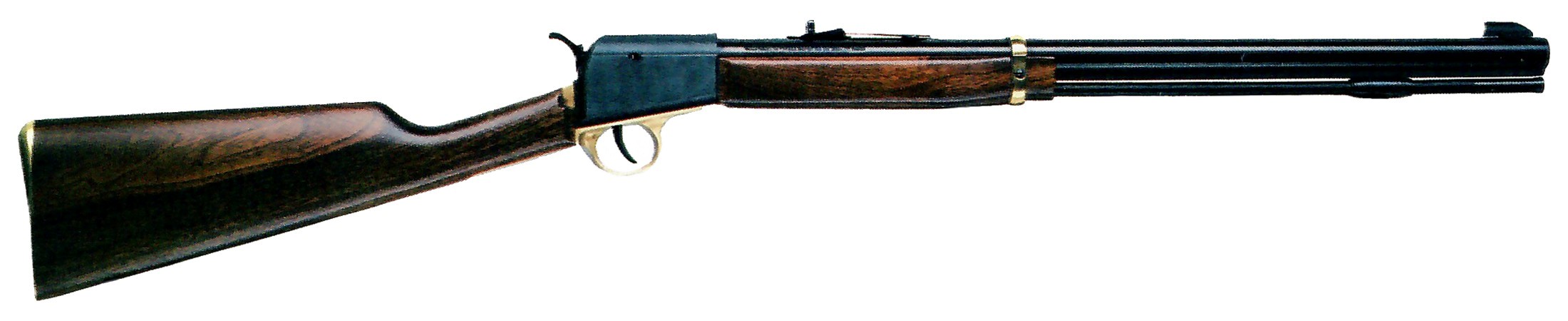
Thompson/Center Scout Carbine
|
Thompson/Center had to react to the new reality in the muzzleloader market. In 1990,
they introduced their first inline muzzleloader, the Scout carbine. Though T/C’s
traditional muzzleloaders were not historically accurate reproductions, they were
steeped in traditional styling. When the time came to introduce an inline muzzleloader,
the first gun they came out with looked very much like an old west lever action rifle,
but missing the lever.
The Scout Carbine was made from 1990 to 1997. It was made in both .50 and .54 caliber.
The carbine had a 21” long barrel with a fast 1:20” twist rate. In 1994, the twist rate
for the .50 cal. was changed to 1:38”, but the .54 stayed at 1:20” until the next year,
1995, when it too changed to 1:38”.
In 1995, a rifle version was introduced in both calibers with a 24” long barrel. The
rifle was made for only three years, up to 1997. That was the last year that both
versions of the Scout, carbine and rifle, were made.
Gregg Ritz, the past and now again current CEO of T/C has said that a Thompson/Center
Scout was the first long gun of any kind that he started hunting with as a teenager,
and that it remains a nostalgic favorite for him today.
The Thunder Hawk
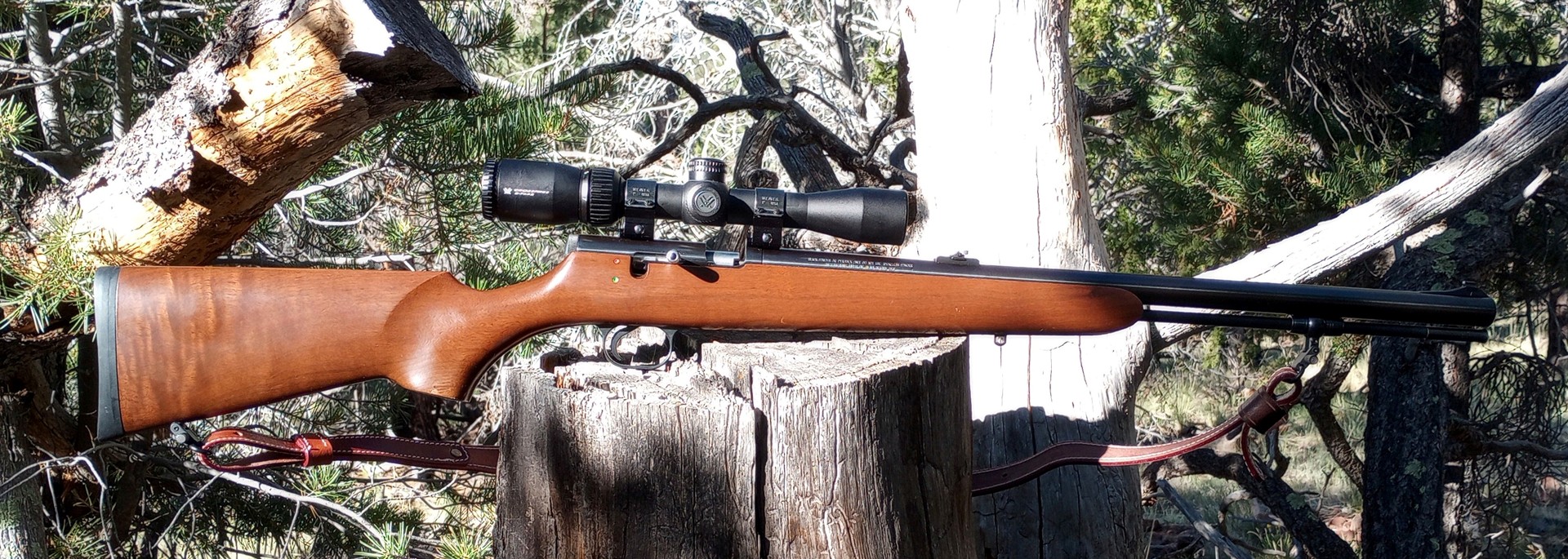
T/C introduced their second inline muzzleloader in 1993, the Thunder Hawk. T/C finally had
a muzzleloader that looked and handled like a modern bolt action rifle. At its heart though,
it was just a percussion muzzleloader with the ignition moved to the center of the rear of
the breech instead of off to the side. Rather than a side-hammer touching off the number 11
percussion cap, the cap is struck by an inline manually cocked striker. It’s a pretty simple
mechanism.
These inlines use the same nipple that the sidelocks use, but screwed into the back of the
breech. What looks like a miniature bolt handle is the striker handle. It is pulled straight
back to the rear to cock the rifle and to place the cap on the nipple. The trigger releases
the striker to fly forward under spring pressure to smash the cap. As a safety, the striker
handle can be rotated downward at the rear of its travel to engage a safety notch, appearing
as the position of the bolt handle on a closed bolt action rifle. To take the rifle off-safe,
the handle is pulled back slightly to disengage it from the safety notch, then rotated upward
where it is held ready to strike by the trigger sear.
The Thunder Hawk was initially introduced with a 21” carbine-length barrel, in .50 caliber,
with a 1 in 38” twist rate. A .54 caliber version was introduced in 1994. That same year, a
version in stainless steel with a black plastic stock was introduced. In 1995, the line was
expanded again with the addition of 24” long barrels. Now the original was called the Thunder
Hawk Carbine, with the longer one labeled the Thunder Hawk Rifle. 1997 would be the last year
for the 21” barrel, with the 24” version lasting until 1999 when the Thunder Hawk was officially
retired.
The Thunder Hawk’s breech was not user-removable, just like T/C’s sidelocks, so it was cleaned
similarly. However, this was a little more complicated because you couldn’t just submerge the
rear of the barreled action in a bucket of hot water, especially if a scope was mounted. I
suppose you could, but I wouldn’t do that to any of my scopes, no matter how high the quality.
But before we talk about how to clean one of these, we need to talk about how they get dirty.
A traditional sidelock not only blows smoke out of the front of the barrel, but it also blows
back from the percussion cap nipple. These early inlines do the same thing – they do not have
a closed breech like many of today’s modern muzzleloaders that use a break-action and a #209
shotshell primer.
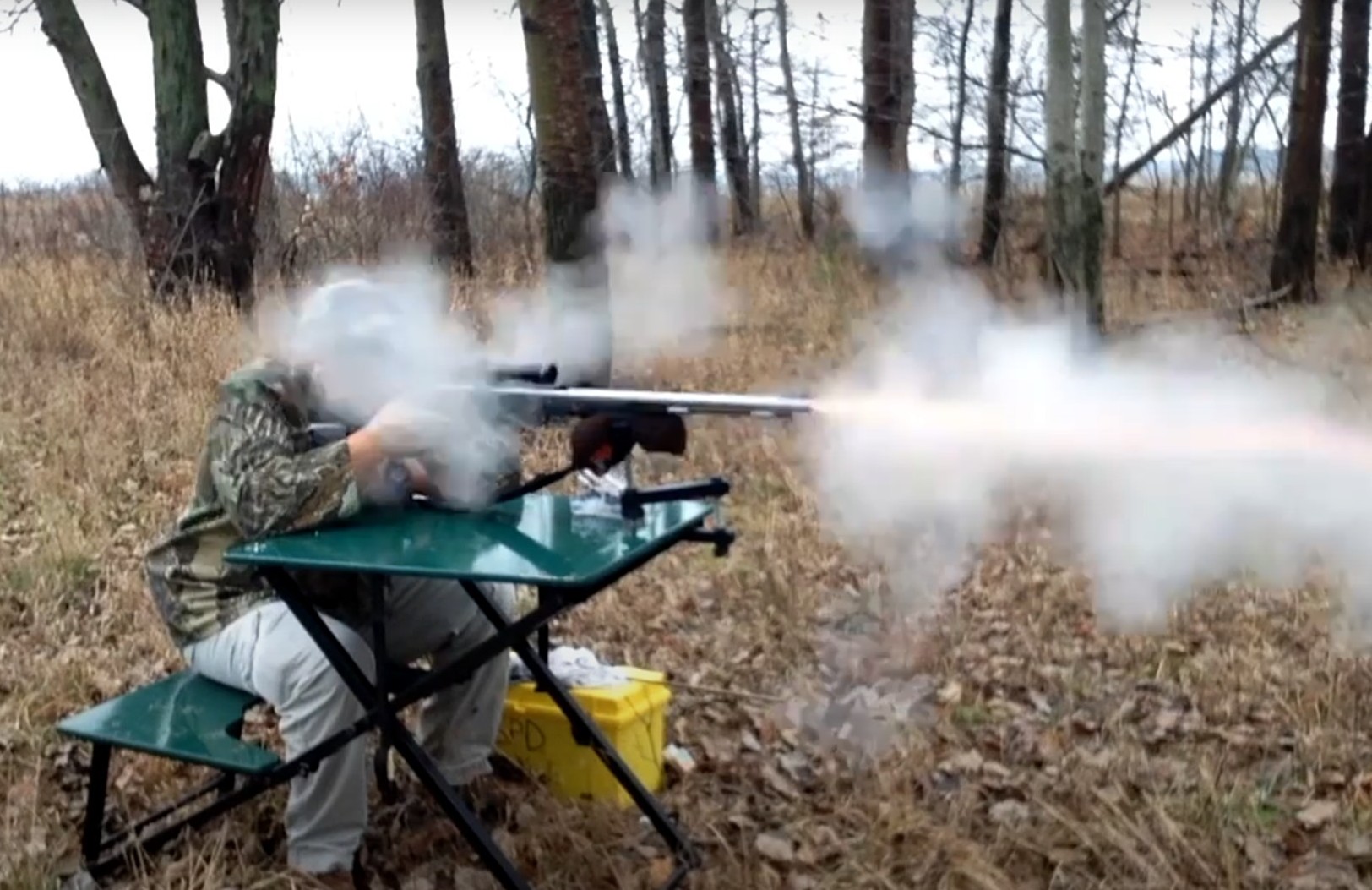
As seen in the photo to the right, considerable smoke blows out both sides of the breech area
of one of these striker-fired T/C inlines. The smoke blows primarily sideways from the cap
and nipple due to the shape of the striker. The striker has an overhang over the top of nipple
that deflects much of the blast that would otherwise go straight up against the bottom of the
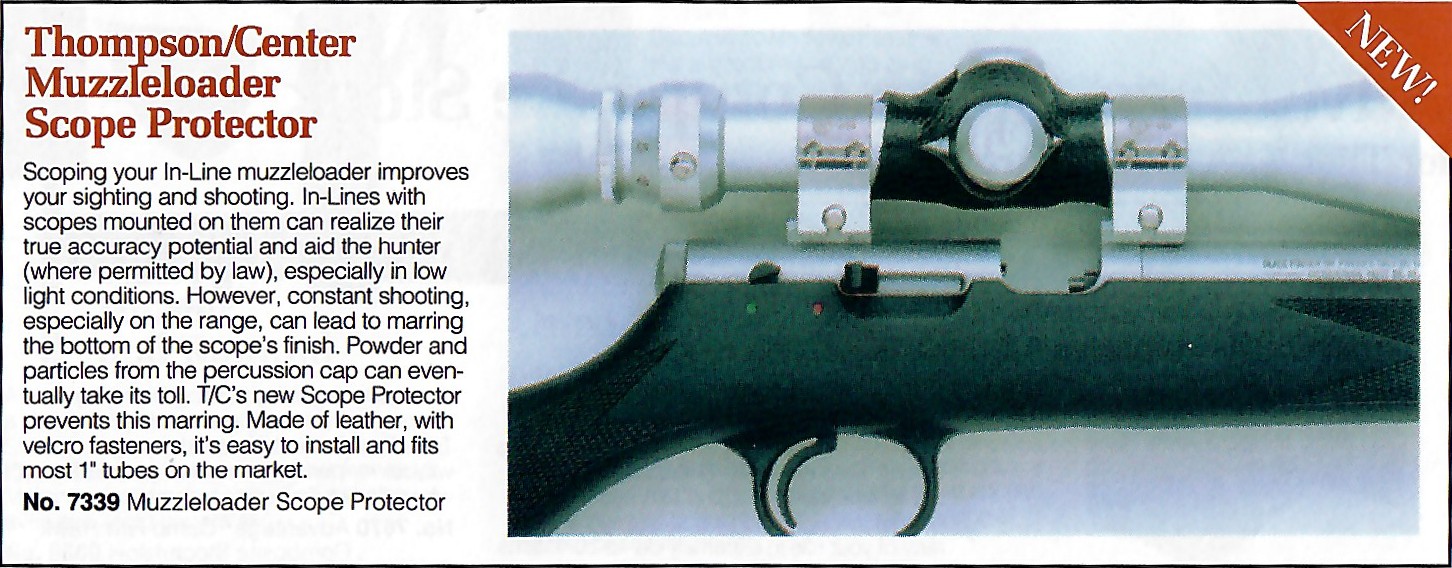
scope. But not all the upward blast is tamed. Among the many accessories that T/C used to
offer back in the day, was a leather scope protector. I ended up making a simple version of
my own.
The Fire Hawk
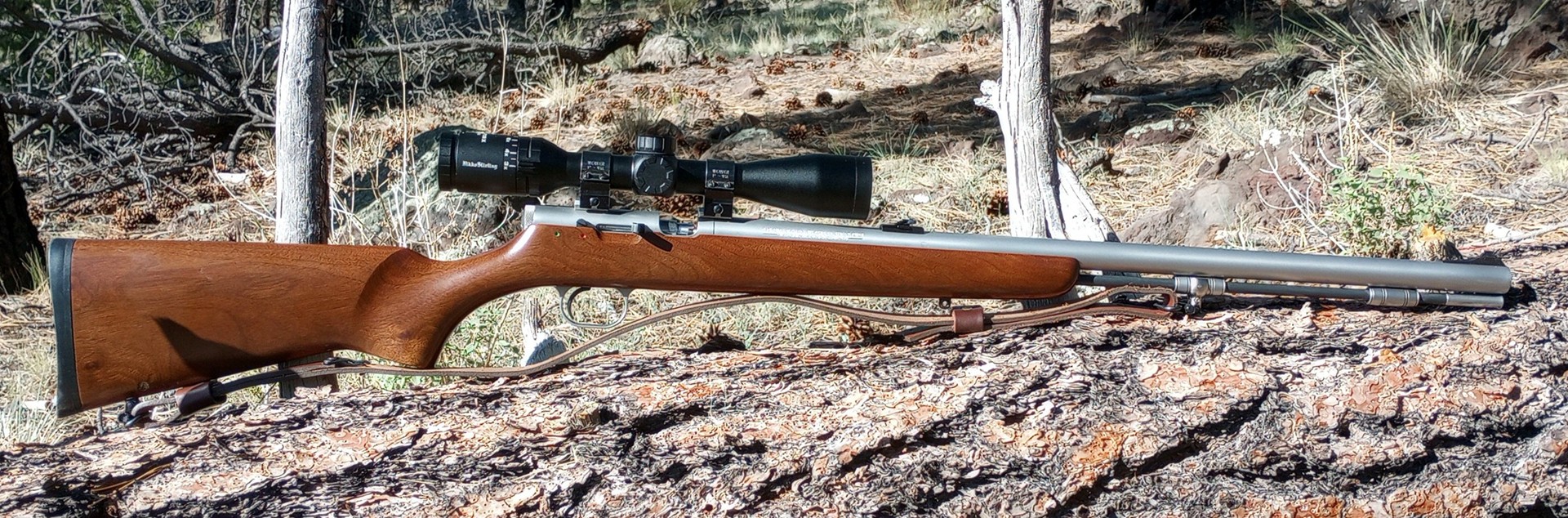
The Fire Hawk was the next evolution of T/C’s striker-fired inlines. The Fire Hawk was quite
similar to the Thunder Hawk with the exception of the safety system. The gun wearing the scope
protector above is actually a Fire Hawk. Instead of a bolt-handle-like striker handle, this one
looks more like the operating handle you would see on a semi-automatic rifle or shotgun. It
only goes back and forth. The safety is the small button located just behind the striker handle
that swings fore and aft. Nothing moves vertically as the striker handle does on the Thunder Hawk.
I believe that both ‘Hawks actually used adjustable BOLD triggers. I measured the trigger pull
weight on the Fire Hawk and the result was an average pull weight of 3 lbs. 14.9 oz. for five
pulls. It’s very crisp.
The Fire Hawk was made for four years, from 1995 to 1998. Production overlapped with the Thunder
Hawk. There were various versions featuring plain walnut stocks, a deluxe version with a
cut-checkered premium walnut stock, black plastic stocks, camo plastic stocks, and a thumbhole
plastic stock. Metal was available in both blued and stainless steel. All versions had a 24”
barrel, with a 1:38” twist. The sole exception to this was a Bantam version with a 21” long
barrel and a shorter length of pull.
Both the Thunder and Fire Hawks were rated for magnum charges up to 150 grains of black powder
or Pyrodex, or up to three 50 grain Pyrodex pellets. CAUTION: If you read the load data in the
manuals, max charge depends on the projectile used. It is not 150 grains across the board.
Manuals with load data for both the Fire Hawk and the Thunder Hawk are still available for
download online. As for myself, so far I’ve only gone up to 90 grains of Pyrodex RS or 80
grains of Triple Seven FFg. My shoulder and face (scope bite) say that’s plenty.
As the TH and the FH were discontinued, there were a couple of other models that took their
place. These were quite similar in their basics, but were further evolutions. The “System 1”
featured inter-changeable barrels and a user-removable breech plug. The System 1 lasted for
only three years, from 1997 to 1999.
The last inline that was based on this basic striker-fired design was the Black Diamond. It
featured a removable breech plug, but did not have interchangeable barrels. T/C tightened the
twist rate on the Black Diamond to 1:28” so that it could handle modern projectiles. The BD
was introduced in 1998, and was discontinued after Smith & Wesson purchased T/C in 2007. So
2006 was the final year of production for the Black Diamond, and thus, this entire series of
T/C's striker-fired inlines.
But here is the good news: These early T/C inlines are highly under-appreciated. I was
able to pick up both the Thunder Hawk and the Fire Hawk each for a dollar or two under $200
delivered. That’s including all Gunbroker fees, sales tax and shipping. The Fire Hawk even
came packed in a very nice gun case which cost the original owner $40 when he purchased it at an Indiana
Rural King
store. Maybe I got lucky finding these two for such reasonable cost, but getting a good deal
on one of these is very possible.
The Thunder Hawk came un-scoped. The Fire Hawk came with a cheap Bushnell. I guess the previous
owner did not know about protecting the bottom of the scope because the scope tube above the nipple
was well charred.
I went to my surplus scope closet and found a couple that I could use on these rifles, a Vortex
Crossfire II 2-7x32mm for the Thunder Hawk, and a Nikko-Stirling Panamax 3-9x40mm for the Fire Hawk.
There’s a good reason that these scopes were in my surplus inventory. The Vortex has a very narrow
eyebox. Your eye has to be in exactly the right place to see through the scope. The Panamax did not
seem to reliably track adjustments. I’m upgrading both of these scopes, then they will go back into
the surplus closet.
As for received condition, both ‘Hawks had very good to excellent bores. Both had very good to
excellent metal externally. Both had very good stocks.
The Fire Hawk however, had some serious corrosion at the rear face of the breech around the nipple.
The outside surface of the striker also showed significant corrosion. I spent a good amount of time
with Cratex rubber polishing attachments on a Dremel tool, doing the best I could to polish out as
much of the corrosion as possible. Thank goodness that this was stainless, instead of blued steel.
I’ll get into this some more later, but cleaning the workings behind the breech is at least as
important as immediately cleaning the bore after a shooting session with these black powder rifles.
The previous owner did not perform this necessary care as diligently as he should have.
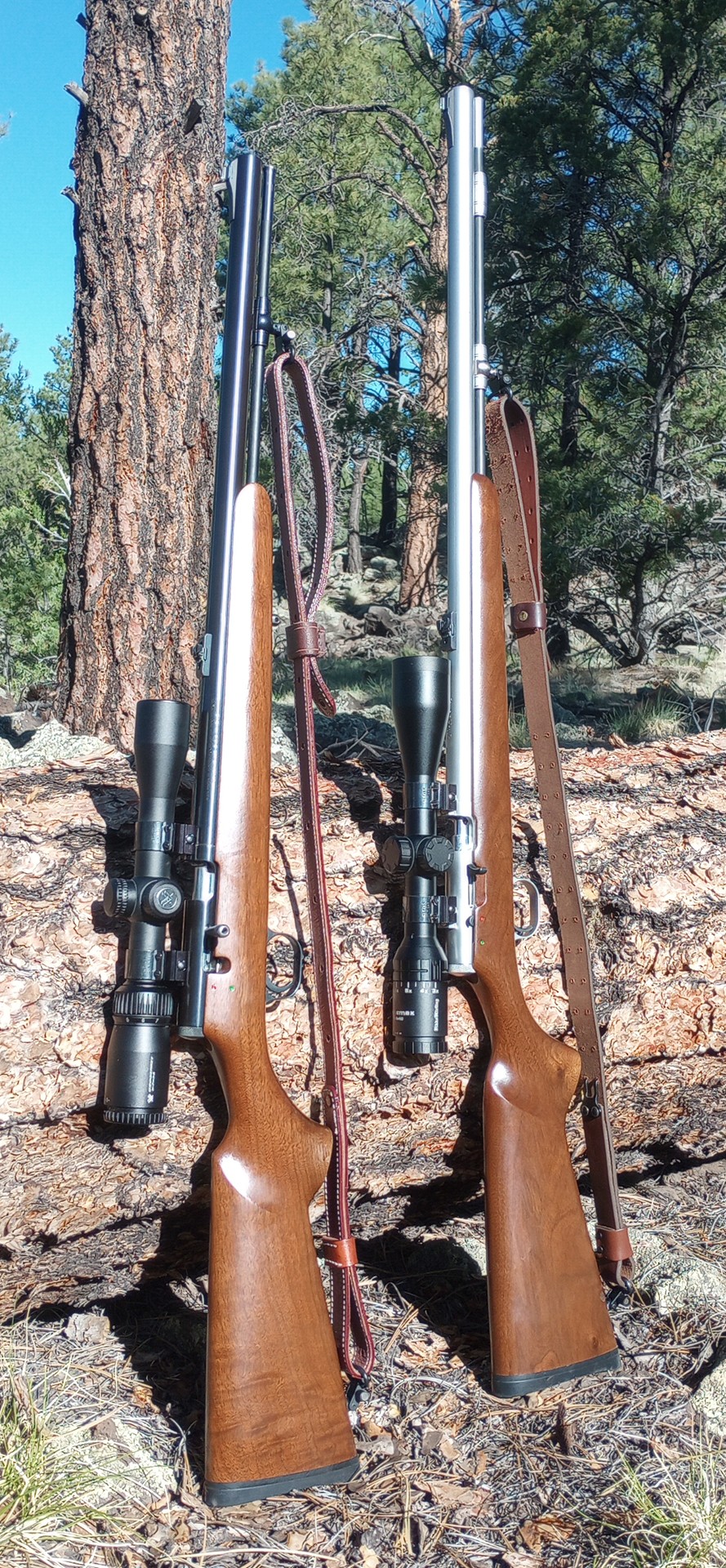
With scopes mounted and slings installed, the Thunder Hawk weighs 7.1 lbs., and the Fire Hawk weighs
7.7 lbs. With both, I installed barrel-band clamping-type sling studs on the first ram rod pipe ahead
of the end of the wood. They both came equipped with sling studs in the forend wood, but when slung
on my shoulder using these mounting points, the barrels tend to point at an angle behind me. I like
the more vertical hang of the rifles on my shoulder when the forward end of the sling is a bit further
toward the muzzle.
The Fire Hawk, with its longer barrel and slimmer stock, feels quite well-balanced in the hands. Its
overall length is 42”. Its balance point is at the 22” point measured from the muzzle, so the weight
is very slightly buttstock biased.
The shorter Thunder Hawk feels like carrying a club by comparison, but I’m sure that its handier
proportions and lighter weight will be appreciated when traveling through the rough stuff. It does
feel quicker to point.
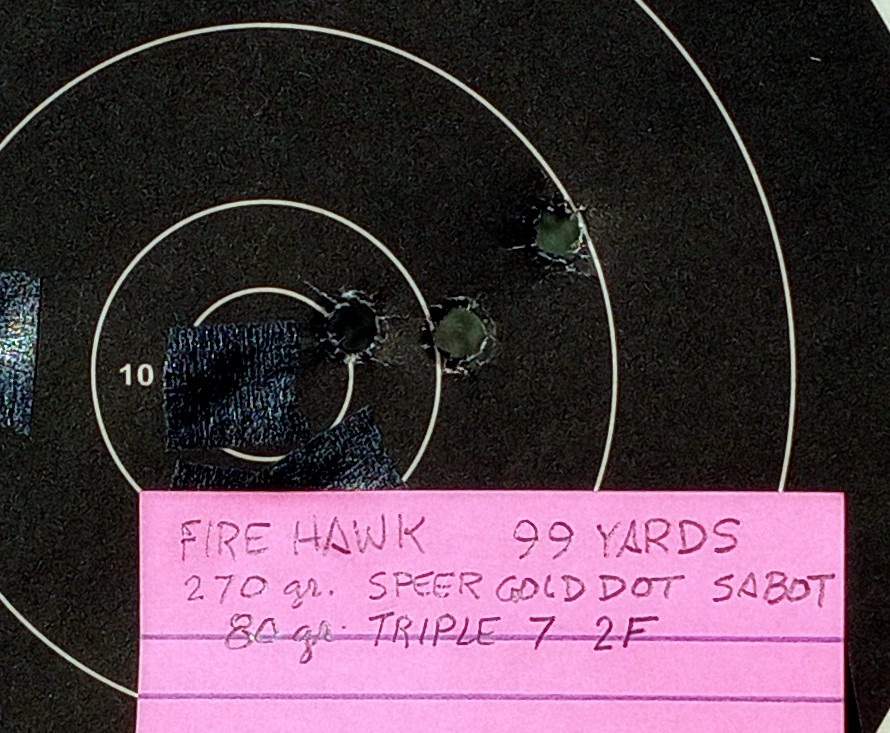
Fire Hawk: 1.17” 3-shot group at 99 yards
|
How Do They Shoot?
After struggling to achieve 3” groups at 65 yards with the iron-sighted sidelock cap guns, it was
quite a delight to see 3-shot groups consistently come-in at half that size, sometimes better, with
these scoped inlines.
First shots with the Fire Hawk though, were a little rough. The load was 90 grains of Pyrodex RS,
with the 240 gr. Hornady .430” XTP in a Harvester Crush Rib sabot. On my 2nd shot, the No. 11
percussion cap did not ignite on first try. I re-cocked and tried again. It ignited and the
rifle fired on the 2nd try. On the 3rd shot, the cap fired, but the charge did not. I recapped,
then it fired. Hmm. As I continued firing, I was getting intermittent delayed fires.
I stopped to clean the gun. After cleaning, the first shot was a misfire. At that point I noticed
that the cap did not seem to seat properly on the nipple. I had some new nipples with me, so I
changed the nipple. (Later at home, I discovered that the nipple that came on the gun was peened
due to dry firing.) This new nipple had a longer cone where the cap seats, but at least the caps
seated well now.
The misfires seemed to stop, but I was still sensing delayed ignition. Not exactly hang fires,
where the cap goes POP, then a second or two later you get the BOOM. More like a half-second or
less delay – noticeable, but barely. I decided to put the Fire Hawk aside for now and moved on
to the Thunder Hawk.
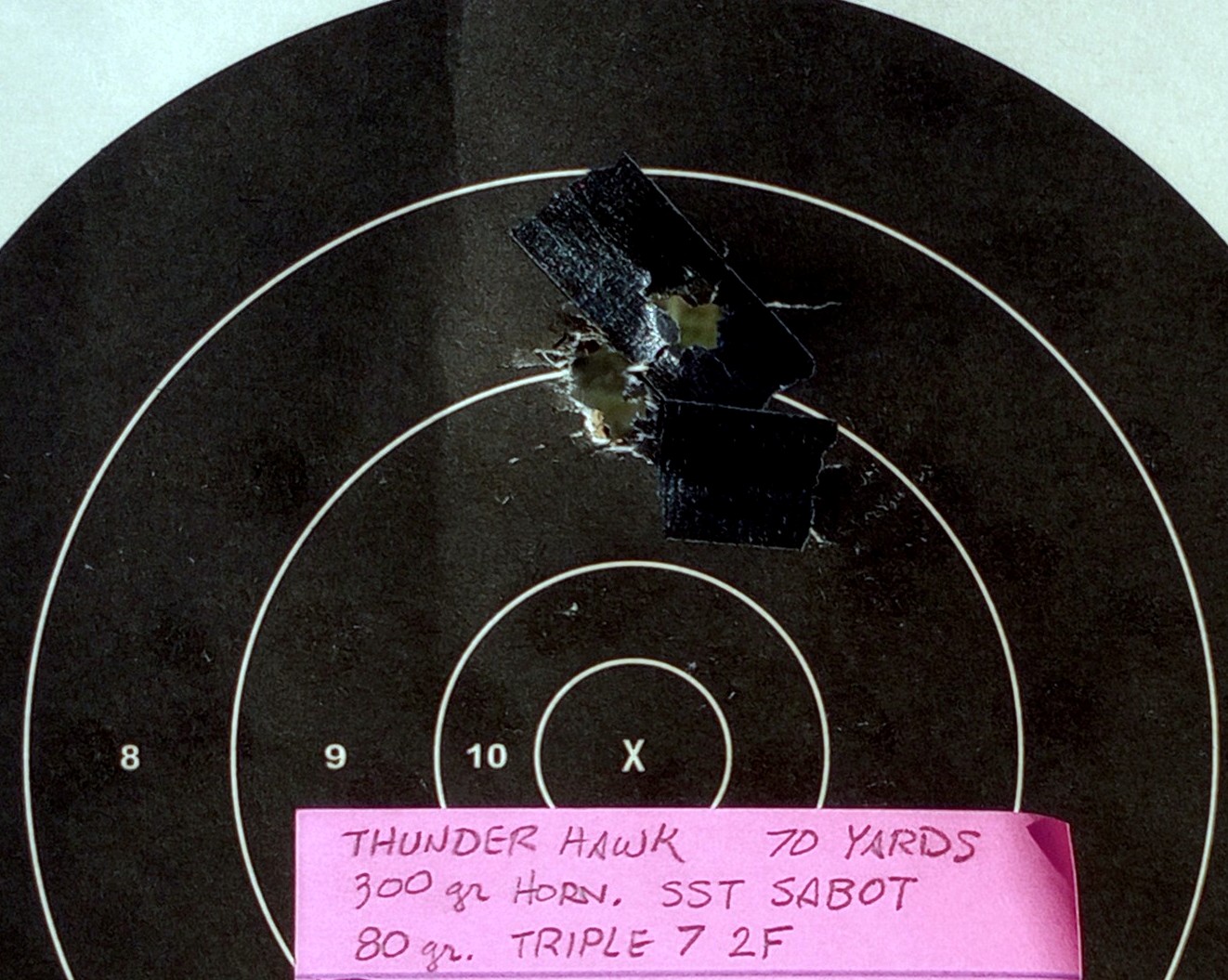
An exceptional 0.69” group from the Thunder Hawk at 70 yards
|
First shots with the TH were at 50 yards to get the feel of it, and to zero the scope. The load
was similar to what I was shooting in the Fire Hawk, but with only 80 grains of Pyrodex RS to
start, and again, the 240 gr. XTP in Harvester sabots. Next I moved on to 75 yards to fine tune
the zero. I increased the charge to 90 grains. In all the shooting I did with the Thunder Hawk,
I had zero ignition problems. The charge ignited immediately every time I pulled the trigger.
Before I got pulled-in by these muzzleloaders, the new Smith & Wesson Model 1854 lever action in
.44 Magnum had been calling to me loudly. Last month I mentioned that these T/C’s basically hit
like .44 Magnum in a rifle. The numbers I’ve been seeing, both for velocity and kinetic energy,
many involving .44 caliber bullets, bear this out. I’m not even pushing the powder charge as hard
as I could. There’s headroom available that I haven’t yet been using.
After spending time with these inlines, I would now say that the accuracy performance likely
matches what a new production .44 Mag lever action could do as well. Of course the lever action
holds advantage for speed of repeat fire.
As for the Fire Hawk, I decided to give musket caps a try. Musket caps are larger than No. 11
percussion caps. They contain more priming compound, so they give a larger flame volume than
No. 11’s. They also have “wings” which makes them easier to handle. The only thing I had to
do to the gun was to change to a musket cap nipple.
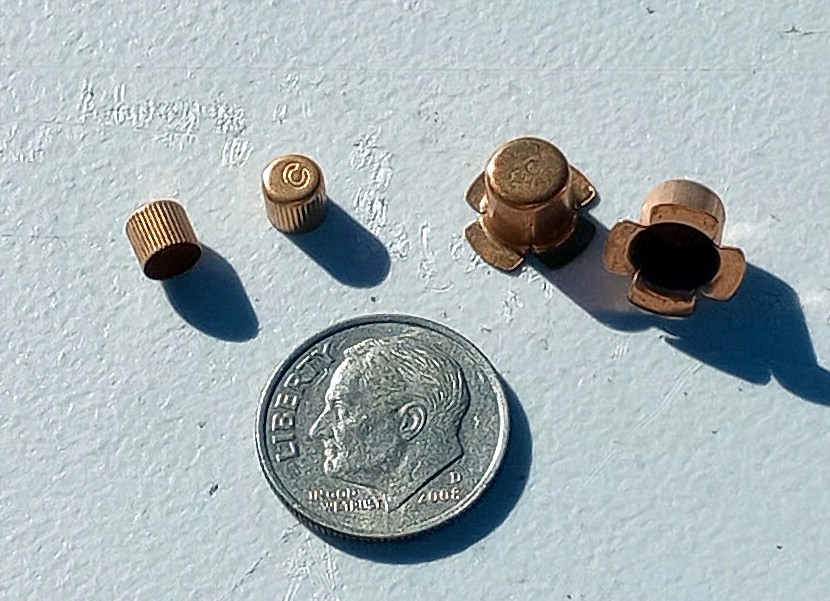
Left: No. 11 caps — Right: Musket caps
|
After making the change to musket cap ignition, the Fire Hawk has run with immediate powder
ignition, 100% of the time. Did it really need that cure? Not sure. Later, I came to learn that
the long-cone No. 11 nipple I tried was not the right spec for a T/C. Both cone length and thread
length matter. Besides the longer cone, it also had a slightly too long thread on it. It seems
that learning about the finer details of these smokers never stops.
If I should ever get into a supply shortage problem with musket caps, it’s simple to change back to
No. 11 ignition. I ordered up three of the correct No. 11 nipples, so now I have the right spares
that will work for any of my T/Cs.
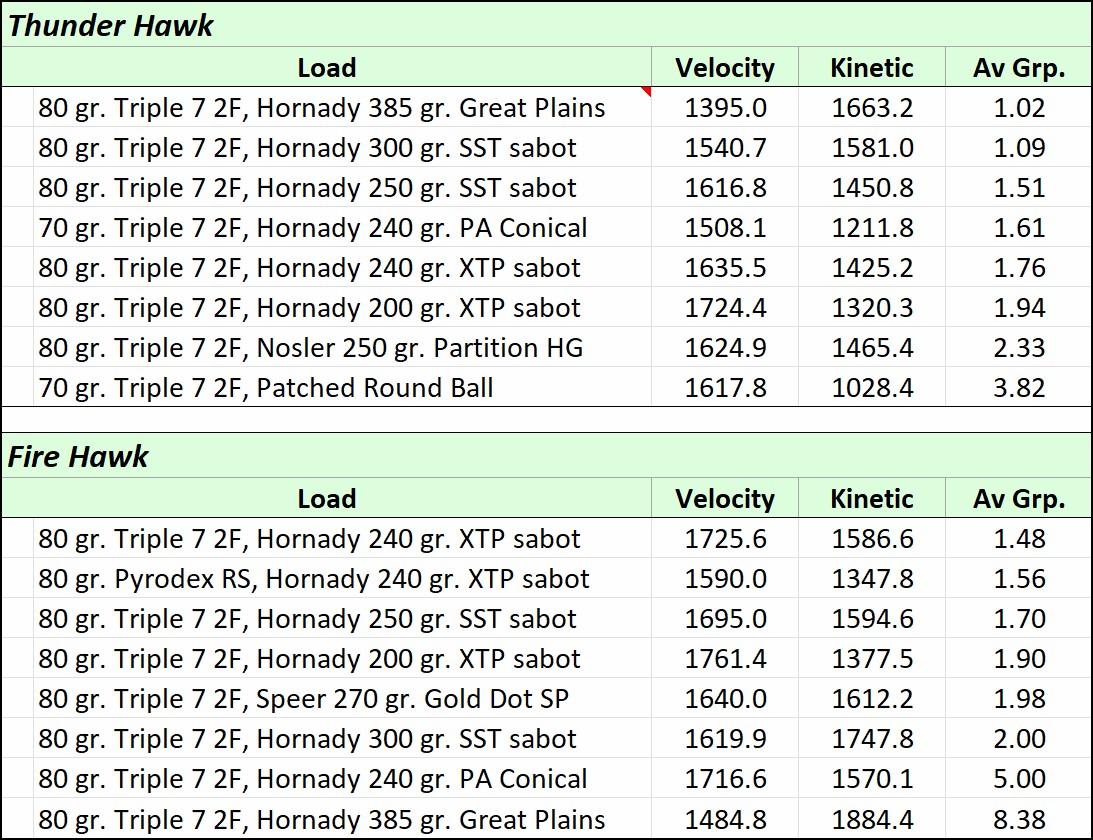
The table below is the result of a lot of shoulder torture for this story. I shot two 3-shot groups
for every load. The distance was 65 to 70 yards. I did this shooting over several days in different
locations out in the wild, and target placement was not always perfectly consistent.
Though the Thunder Hawk is listed first, I actually shot the Fire Hawk first. I need to mention
this when you notice that the Thunder Hawk shot its best groups with the 385 gr. Hornady Great Plains
bullet, but the Fire Hawk shot its worst with the very same. I made one small change when I shot
the Thunder Hawk: I added a felt wad between bullet and powder when I shot these full-bore-sized
conicals.
I will have to go back and re-test the Great Plains bullet in the Fire Hawk with the felt wad.
However, there could be another factor at play here. That factor is that the Fire Hawk has the QLA
false muzzle feature, but the Thunder Hawk is pre-QLA. In my recent “T/C Catalog Disease” story I
mentioned that many shooters report seeing poor accuracy with full-bore lead conicals in QLA barreled
guns. Is that what bit me here? The PA Conical, another full-bore lead bullet, was also bad in the
Fire Hawk, OK in the TH.
Other things of note: Most of the loads listed here were shot using Triple Seven powder. I had been
using Pyrodex RS up until now. I found that Triple Seven is a much cleaner powder. There is less
fouling between shots, which meant that I didn’t have to swab the bore as often while I was doing all
this shooting. Cleanup at the end of the day was easier.
There is one load in this data set that used Pyrodex – the second line in the Fire Hawk data. But I
also shot this same bullet, with the same charge volume using Triple Seven. The average velocity using
Pyrodex was 1590 fps, while the Triple Seven load shot at 1726 fps – considerably faster. This is also
reflected in the kinetic energy figures of 1348 ft.-lbs. versus 1587 ft.-lbs. Apparently Triple Seven
is also a more energetic powder. I’ll be totally switching over to Triple Seven after I burn up my
remaining stock of Pyrodex.
But the overall take-away from this data is that accuracy is easily good enough for hunting out to
at least 100 yards, and probably somewhat beyond. The two inline ‘Hawks will be the muzzleloaders
of choice for my upcoming H.A.M. elk hunt in November.
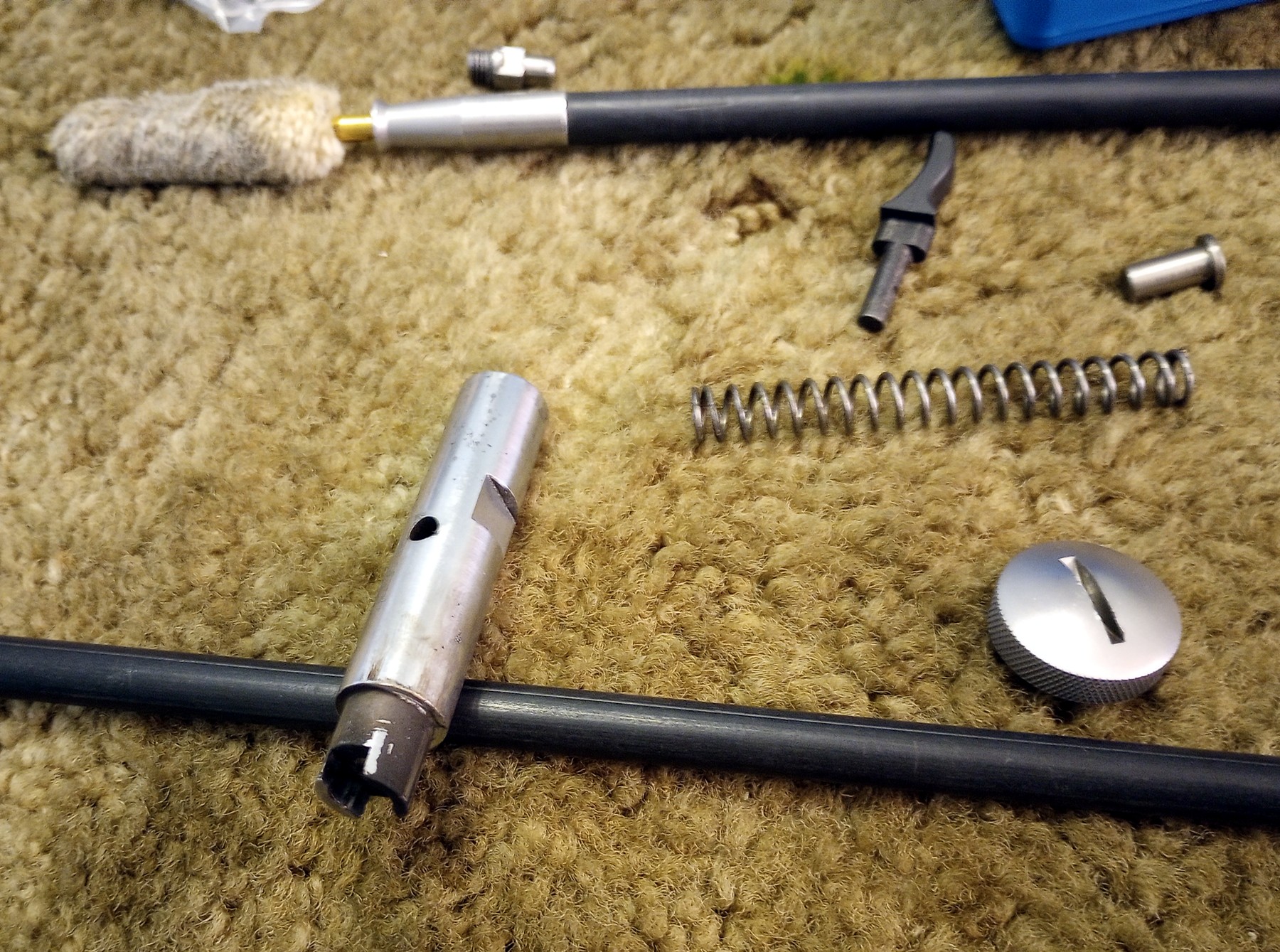
Receiver parts: Dirty striker (laying on a ram rod at the bottom),
receiver end cap (at right above the lower ram rod), striker spring
(above end cap), striker handle (above spring); striker handle
retainer (to the right of the handle), nipple (above top ram rod).
|
Cleaning
Cleaning one of T/C’s sidelock muzzleloaders is easy, at least as long as it is not wearing a scope.
You knock out one barrel wedge, then you can lever the barrel up from the stock. That allows the
hook at the end of the breech to clear the breech end of the stock. Voila! The barrel and stock
are separated. Now you can place the breech end of the barrel into a pail of hot soapy water and
start pumping the water through the barrel with patches on a jag on your ram rod.
With these early T/C inlines with a fixed breech, the concept is the same, but the execution is
different. The first step is to remove and set aside the gun’s ram rod. Now, separate the barreled
action from the stock by removing two screws on the bottom. One is at the rear of the trigger guard,
and one threads into the recoil lug attached to the bottom of the action. This process should be
very familiar to anyone that has disassembled a bolt action rifle.
Control the striker handle and pull the trigger to ease the striker forward, releasing spring tension.
At the rear of the receiver is the receiver end cap. It has a knurled edge and a large slot at the
rear. I made a special tool that fits the slot and attaches to a screwdriver handle to unscrew the
end cap without causing any damage. Now all the parts related to the striker mechanism can be removed
from the receiver.
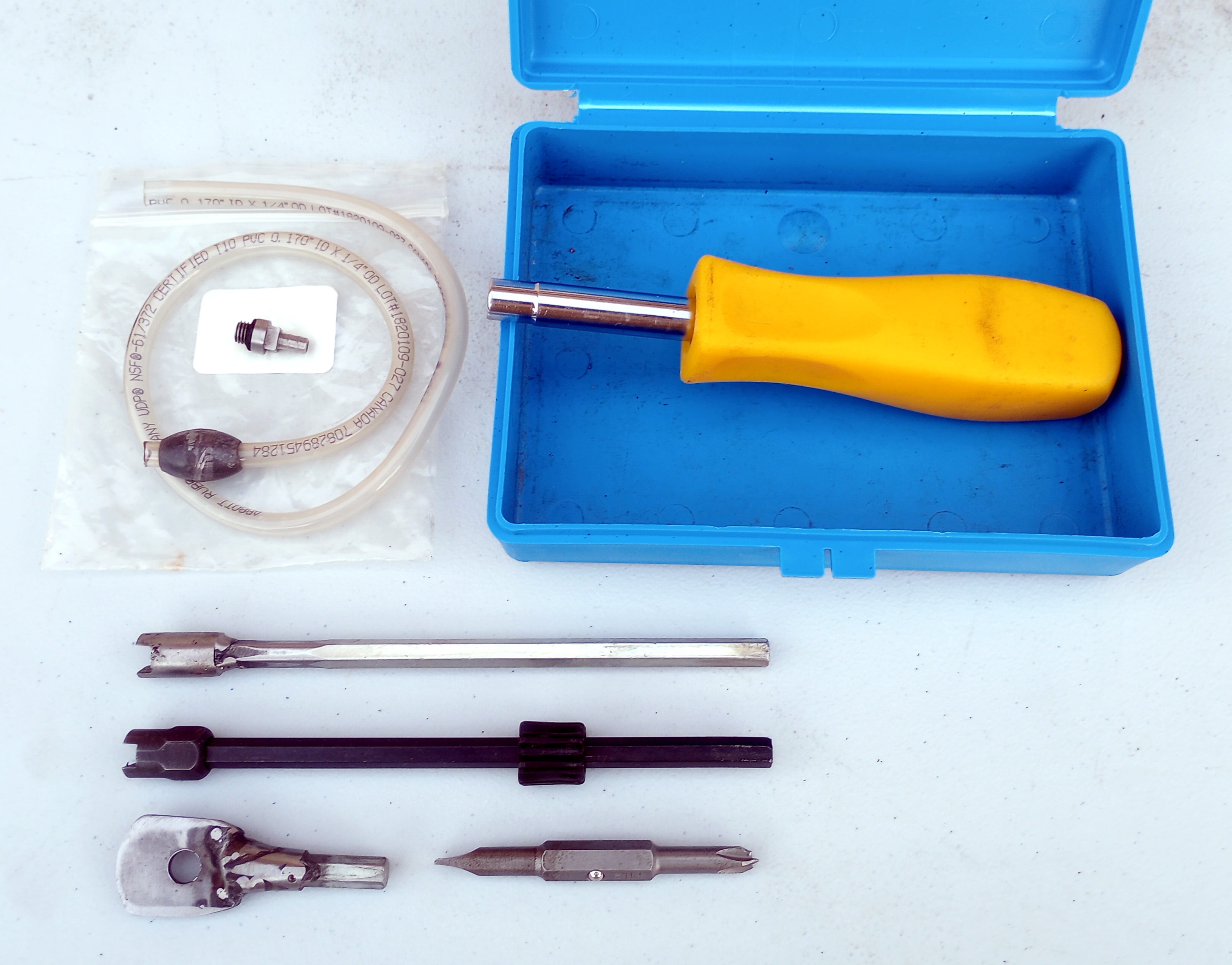
Removing the nipple takes a special long nipple wrench to reach through the back of the receiver. I
found a New Old Stock T/C wrench for No. 11 nipples on eBay, but I had to make my own for the musket
cap nipple. Here’s the toolkit I assembled for maintaining these inlines:
The musket cap nipple wrench and the end cap removal tool I crudely welded together, but they work.
The musket cap nipple wrench also works for the flush nipple.
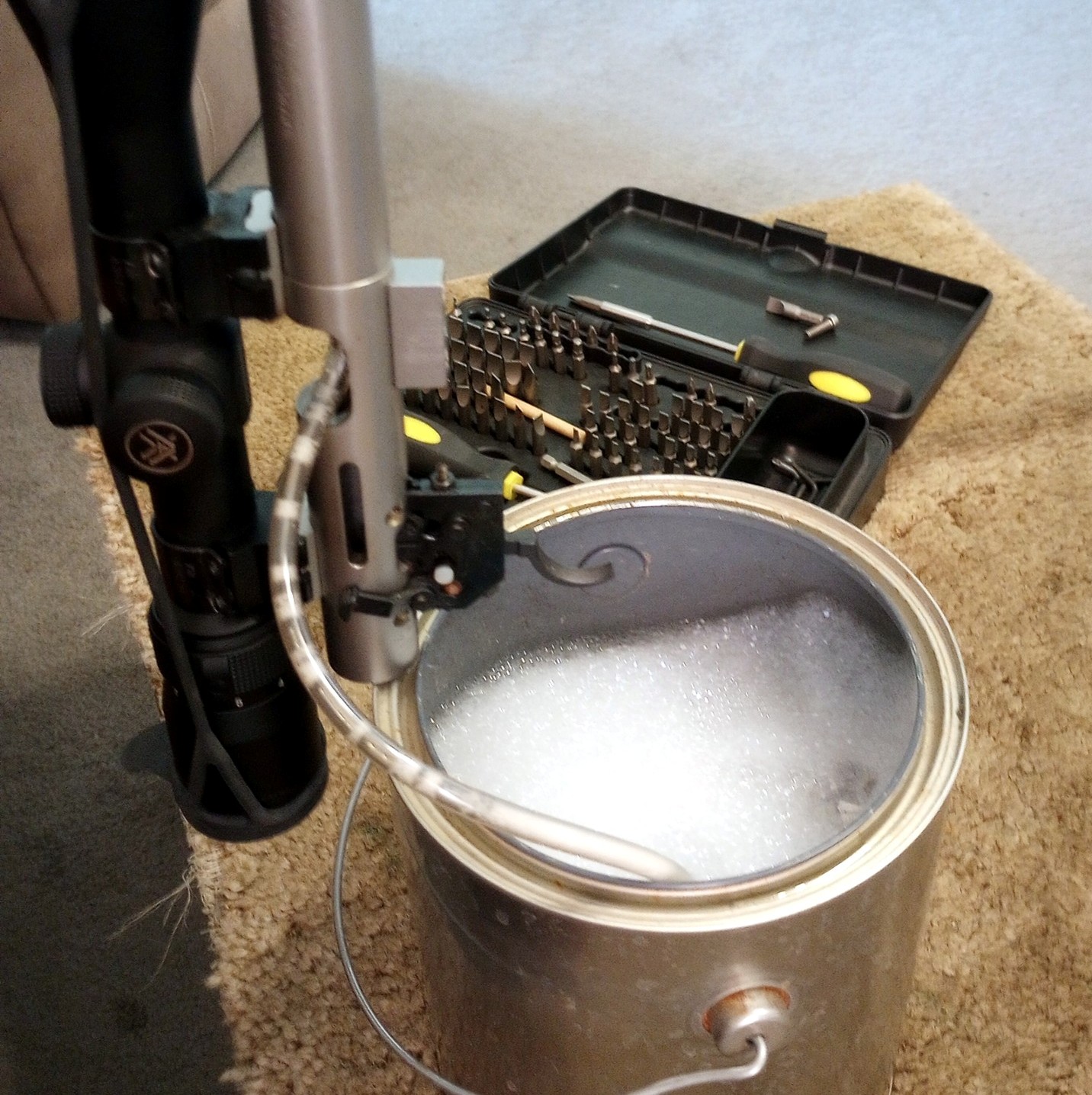
Flush nipple? That’s how you can pump hot water from a bucket through the barrel without submerging
the scope. After flushing, then dry-patching the barrel, I wrap a dampened 3”x3” patch around the mop
pictured at left to clean the inside of the receiver and the rear face of the breech. Clean all the
soot from the striker face and body. Clean nipple, put anti-seize grease on the nipple threads and
re-install. I lightly oil the outside surface of the striker with 3-In-One brand silicone oil, then
re-assemble everything.
These early T/C inlines handle like a modern bolt action and are decently accurate. Though they may
lack the historical aesthetic that the sidelocks have, now that they are around 30 years old, they
have a vintage appeal of their own.