Last month, after mentioning the large number of muzzleloader
models that T/C used to make in their heyday, of course I need to introduce you to a
few more of them, right? Certainly you didn’t think that I would just leave you hanging.
I’ve already introduced you to the blued metal, wood-stocked, 26” barreled New Englander,
and the stainless steel, plastic-stocked, 24” barreled Grey Hawk.
After this spring’s H.A.M. javelina hunt where I only had those two black powder rifles
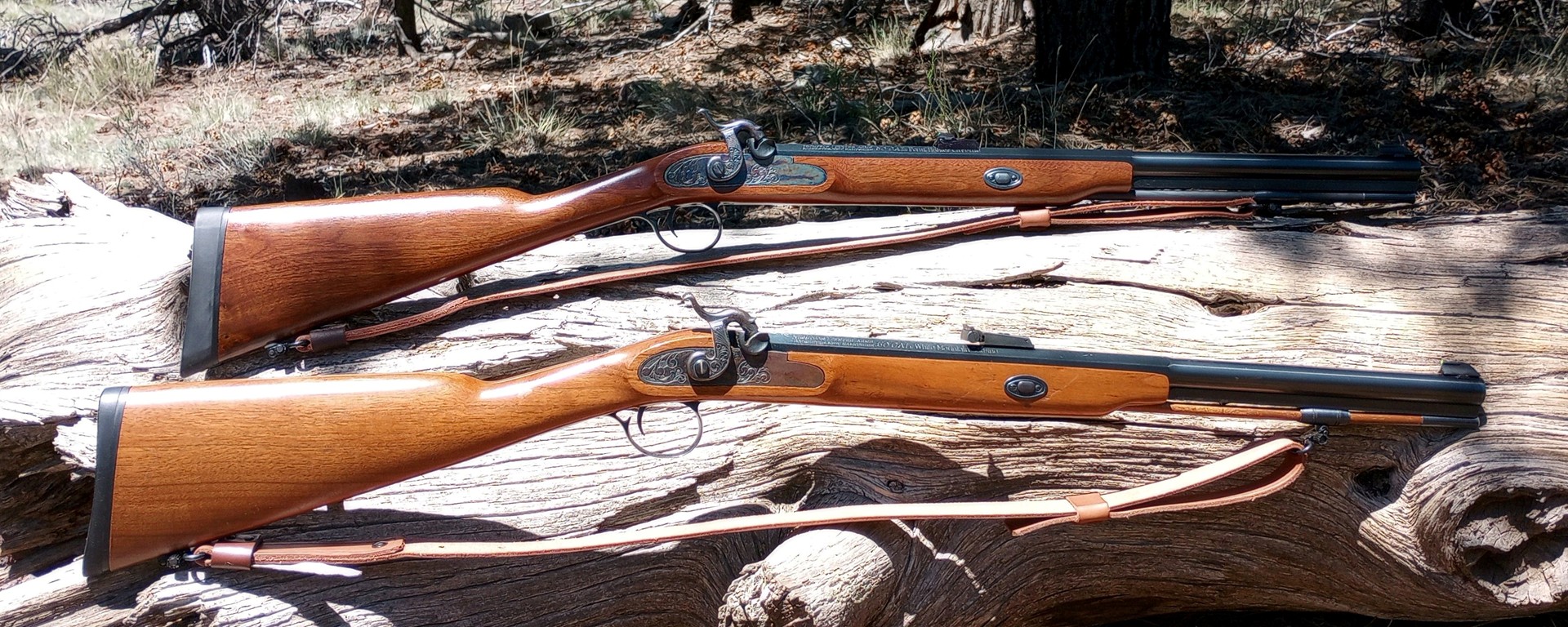
to equip my crew of three hunters, I decided to acquire two others. These two, a White
Mountain Carbine and a Pennsylvania Hunter Carbine, look nearly identical, but they are
not.
Both are walnut-stocked, and have half-octagon, half-round barrels 21 inches in length.
Compared to the New Englander and the Grey Hawk, the shorter barrels of lighter contour
make them much friendlier to carry when hunting. Here are the comparative weights (all
with slings attached):
|
New Englander (26”) |
8.1 lbs. |
|
Grey Hawk (24”) |
7.5 lbs. |
|
White Mountain Carbine (21”) |
6.5 lbs. |
|
Pennsylvania Hunter Carbine (21”) |
6.1 lbs. |
Here’s what I mean by “lighter contour”. The big guns have full round barrels that
measure 1.030” at the breech, tapering very slightly to .905” at the muzzle (.925” for
the 2” shorter Grey Hawk). On the carbines, the octagon portion measures 15/16” (.94”)
across the flats. At the front of the stock, where the barrel leaves the wood, the
barrel transitions to round, with a diameter of .885”. All four have .50 caliber bores.
The weight difference between the two carbines may be due to a difference in the density
of the wood, but the PA Hunter’s stock does seem to be a little more delicate in form.
It’s wrist is noticeably slimmer.
What really sets the two carbines apart from each other, but also apart from the New
Englander and the Grey Hawk, is their twist rates. The New Englander and the Grey Hawk
both have barrels with a 1:48” twist rate. The T/C Hawken and Renegade in .50 caliber
also use the 1:48” twist rate. This is the same twist rate that the Hawken brothers used
in their famous plains rifles that equipped the mountain men. This twist rate is
considered the universal, or a compromise twist rate for traditional muzzleloading rifles.
Rifles with this twist rate can shoot both patched round balls and heavy lead conicals with
decent, but maybe not optimum accuracy.
The White Mountain Carbine
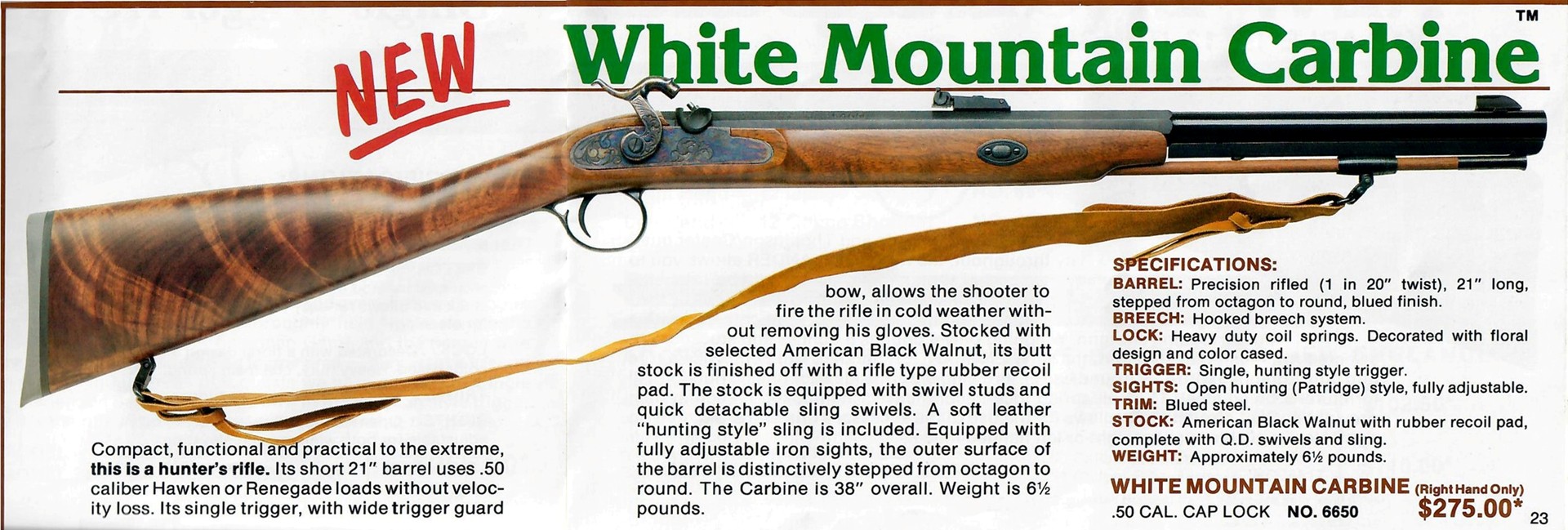
The White Mountain Carbine was introduced in 1989 and ran for seven years, to 1995. While
we in Arizona have our own beloved White Mountains, it was named for the better-known White
Mountains of New Hampshire.
The twist rate of the White Mountain Carbine is very fast for a .50 caliber muzzleloader
at 1:20”. This is faster than most modern muzzleloaders designed to use the most modern
muzzleloading bullets. Today’s high-performance muzzleloaders typically use a 1:28” twist.
What is interesting is that for the last two years of production, the WMC’s twist rate was
changed from 1:20” to 1:38”. The faster twist is not good for round ball accuracy. Round
balls will shoot OK with light charges in the slower 1:38” twist. Maybe that was the reason
for the change.
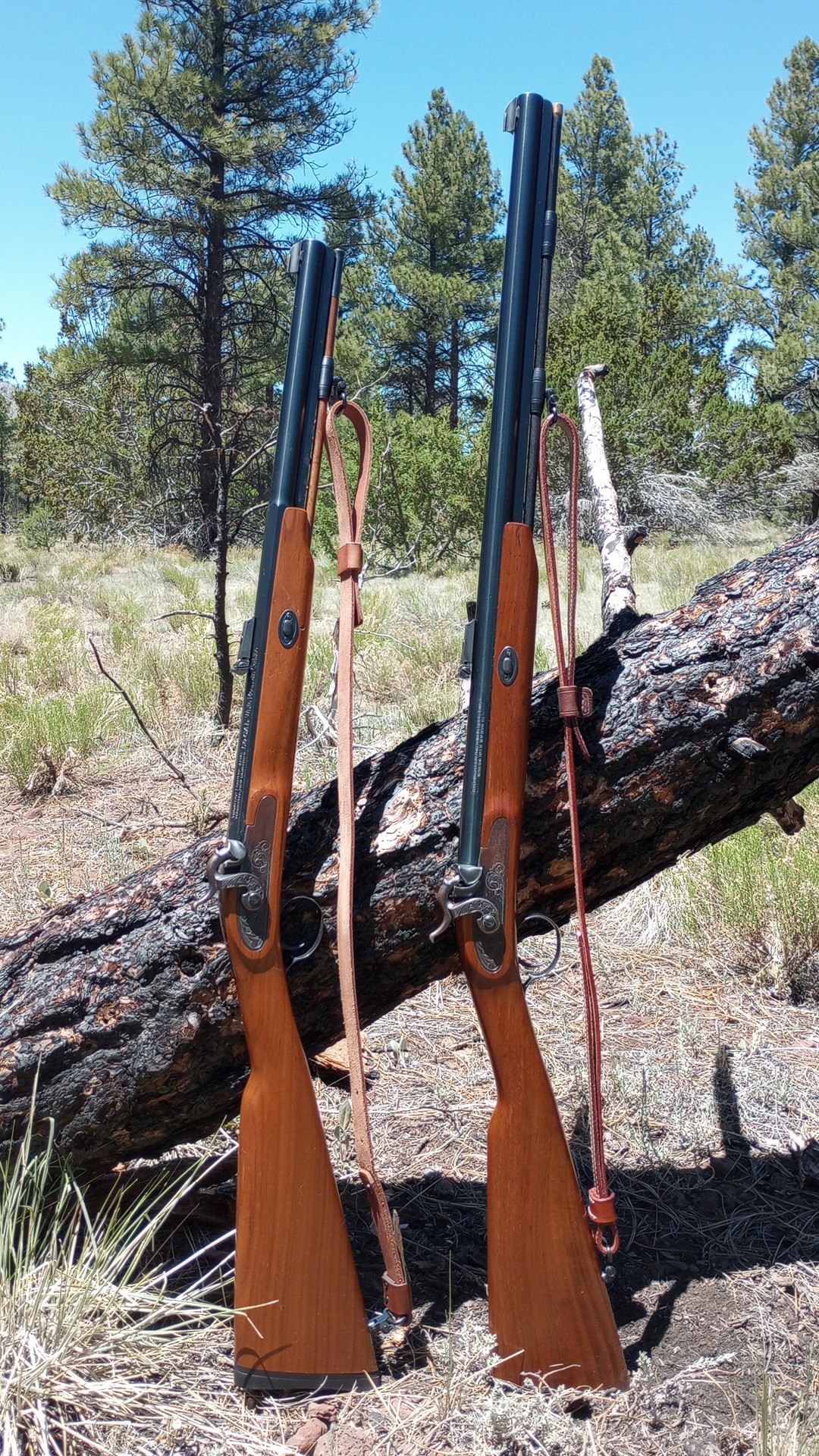
Size comparison: White Mountain Carbine
on the left, New Englander on the right
|
I spent $371 and change on the White Mountain Carbine, delivered. When it arrived from
Indiana, the bore was dirty and rusty, and the percussion nipple was seized with black
powder grime and rust. I spent several sessions scrubbing out the bore, both with patches
wrapped around a .50 caliber jag, and around a .50 caliber bronze brush. I got it as clean
as I could.
I was able to free the old nipple and tossed it in the trash. The nipple threads in the
breech were rusty so I scrubbed them with a bronze brush and oil, then installed a fresh
and shiny new nipple.
The stock is not pristine either, but overall, not too bad. There’s a compression ding
or two, some shallow scratches, and a number of places where the top layer of the finish
is flaked away. If I wanted to spend the time, I could strip, steam, and refinish the
stock, but I have not yet worked up that much ambition. If its role is to be a
javelina-hunting loaner, then it's condition is fine as-is.
After the cleaning, the next thing that I did was to half-fold-over a cleaning patch to
get a tight fit between bore and jag, and pushed it down to the bottom of the bore. I
wrapped a piece of tape around the ramrod at the muzzle and made a mark on the tape at
the position of the front sight. I slowly withdrew the rod, allowing it to spin naturally
with the rifling. When the mark had made a turn of 180 degrees, I measured the distance
from the muzzle to the bottom of the piece of tape – 10 inches. This confirmed that my
White Mountain Carbine was an earlier production model with the 1:20” twist barrel. It
does have the breech-block screw hole (discussed last month), so it was made in ’91, ’92,
or ’93.
One thing that I’ve done now with all my iron-sight T/C muzzleloaders is to paint the
ball of the front sight with Testors fluorescent yellow paint. This
really makes the front sight stand out when aiming. I do this by clamping the rifle
muzzle-down in a gun cleaning vice, supporting the toe of the buttstock against a vertical
surface such as a cabinet door. Then, taking a wooden toothpick, dip the pointy tip
into the paint, then transfer a drop to the front sight ball. I let it dry, then apply
another drop. Maybe a third time. On one application, the paint may be a little
transparent so you don’t get the full solid glowing color, but multiple coats (drops)
result in a nice solid neon color that really pops in the sunlight. Any paint that may
seep down the side of the sight I clean up with nail polish remover.
When I was testing the New Englander and the Grey Hawk, I found that they both shot tighter
groups using saboted .44 caliber Hornady XTP pistol bullets than groups fired with patched
round balls. I keep a good stock of the 240 grain Hornady XTPs plus Harvester
Crush Rib sabots. That was one of the main bullets that I wanted to test in the WMC.
But I also have some .44 cal. 270 grain Speer Gold Dots and some 300 grain Speer plated
softpoints. With the fast twist, I expected it to shoot all of these with good accuracy,
limited only by the iron sights and my old eyes.
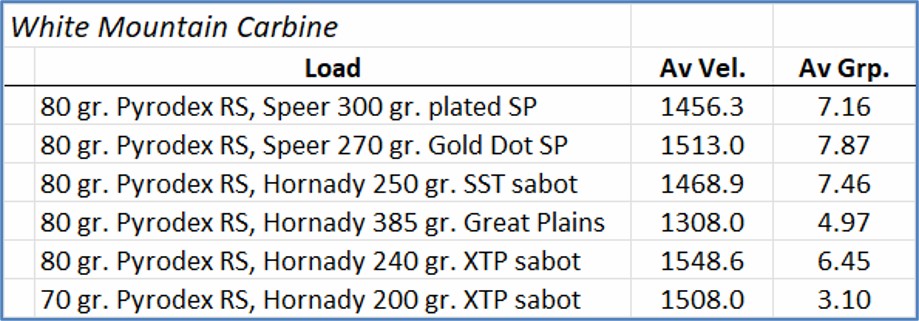
I ended up testing six different projectiles in the White Mountain Carbine. My test
protocol was as follows:
- 65 yard distance
- Two 3-shot groups for each projectile
- Swab barrel between 3-shot groups
- Record velocities
- Measure group sizes
I’ve settled on the 65 yard distance now as my testing and zeroing distance for traditional
muzzleloaders equipped with iron sights. That’s a reasonable outside distance for javelina
hunting, and seems to be within the accuracy and power limitations of these guns. As I’ve
worked with these smokers more and more, I’ve come to think of them as basically
slow-to-reload single-shot .44 Magnum rifles.
As for firing only two 3-shot groups, you’ve got to understand how much time even that ends
up taking. I had a lot of different projectiles to try. With the slow loading process,
plus the requirement to frequently swab the bore, if I was going to get through all the
different bullets I planned to shoot, I had to limit the number of groups. (I also went
through a lot of cleaning patches!)
In the back of my mind was the question whether the WMC would make a decent choice for my
HAM elk hunt in November. With the fast twist, would it shoot the “heavies” with elk
hunting accuracy and power? My hunt is for antlerless elk, which you can often sneak up
to under 100 yards or less. Bow hunters do it all the time.
I ended up disappointed with every load I tried except for the last one, which I decided
will be the javelina load of choice for this gun. The “heavies” kicked the snot out of me
and left me with a bruised and tender shoulder after all this shooting with the light gun
– and I don’t bruise easily.
The kinetic energy of the last, light load is 1010 ft-lbs at the muzzle. A 3-inch group
at 65 yards is adequate for taking a little piggy at ranges up to that distance. I was
surprised at how much better the 200 grain XTP with 70 grains of powder was, than the 240
grain version propelled by 80 grains. Goes to show that sometimes less is more.
The Pennsylvania Hunter Carbine
For many years, the Pennsylvania hunting regulations specified that a primitive
muzzleloader season really meant primitive. Patched round balls only, flint lock
ignition, and iron sights. “For the hunter who prefers, or is required by regulations,
to use a round ball, TC now offers a firearm specifically designed for the purpose. Its
31” barrel is cut-rifled (.010” deep) with a 1 turn in 66” twist.”
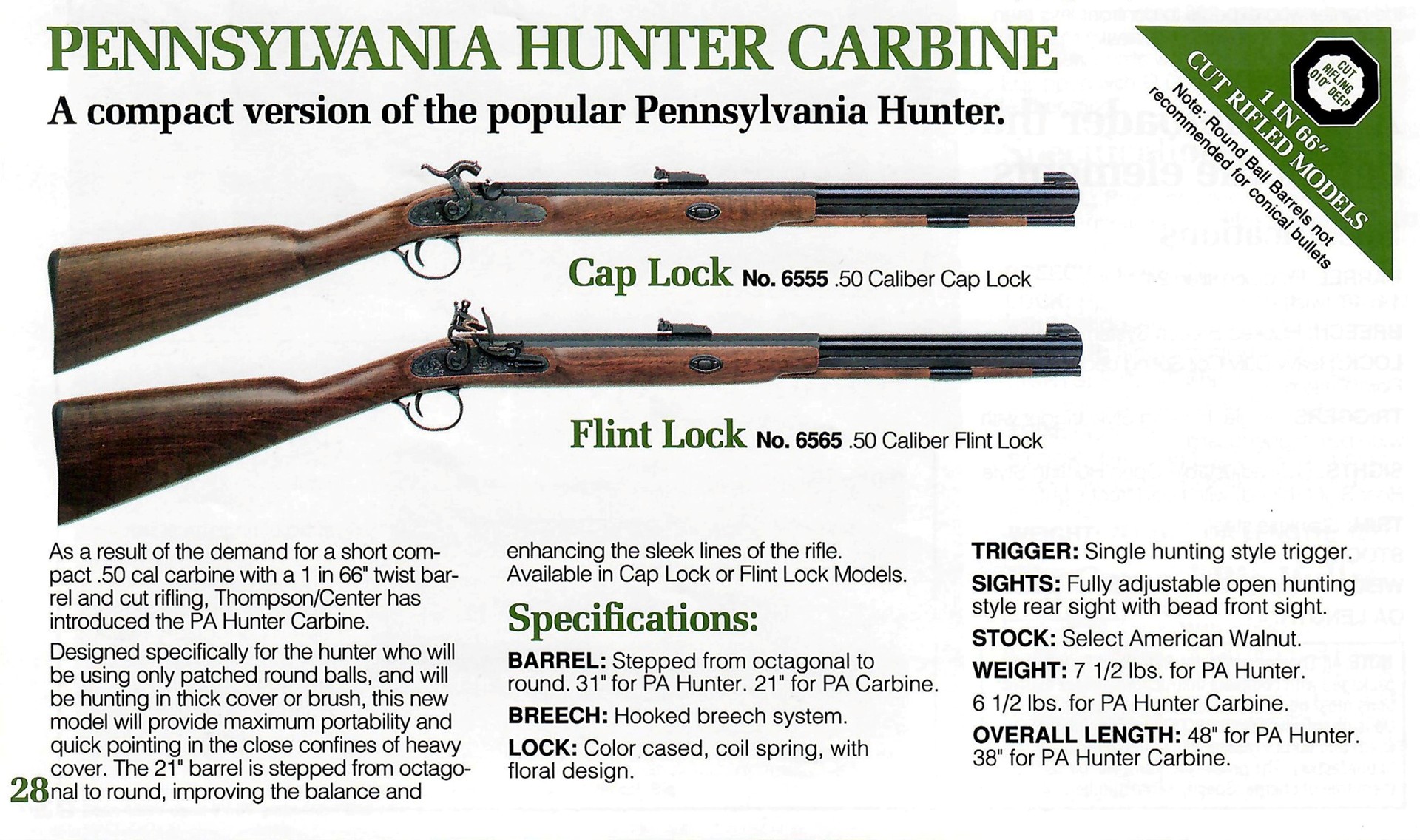
The 31” Pennsylvania Hunter was introduced in 1988 in both caplock and flintlock
versions. A carbine version with a much shorter 21” long barrel was introduced in 1992,
again in both caplock and flintlock versions.
I don’t know if the round-ball restriction still exists, but to this day, Pennsylvania
still has a special after-Christmas flintlock-only deer season. Eventually, the caplock
versions of the PA Hunter rifle and carbine were dropped, leaving only the flintlock
versions by 1996.
The caplock Pennsylvania Hunter Carbine was made for only four years, from 1992 to 1995.
Therefore they are not easy to find. I managed to snag mine on Gunbroker almost as soon
as it popped up. It was set up in an auction where you could make an offer. I did, and
the offer was accepted. Still, it turned out to be my most expensive TC muzzleloader at
$528.52 delivered, but I’m not bothered by that at all.
This PA Hunter Carbine was well taken care of. The bore was clean and the percussion
nipple looked new. The stock is in excellent shape with nary a mark or scuff anywhere.
It came to me with a scope mount, but no rear sight. I took off the scope mount and
stashed it away for possible future use. I installed a Williams fiber optic rear sight
on it, but kept the stock steel front sight. Of course I painted the ball of the front
sight fluorescent yellow. In the sunlight, it glows almost as brightly as the fiber
optic dots on the replacement rear sight.
I was interested in the slow-twist PA Hunter Carbine because I wanted to see just how
accurately a muzzleloader could shoot patched round balls. Patched round balls are the
cheapest projectiles you can shoot in a muzzleloader. For plinking and practice, that’s
the projectile of choice. Plus, there is just something very cool about shooting round
balls that transports you back in time to the way it used to be.
Patched round balls shoot most accurately with a slow twist of 1:66” or 1:72”. Deep
cut grooves of around .010” grab onto the patch with no slip so that the spin is
effectively imparted to the ball. The standard T/C 1:48” barrels are button-rifled
with a groove depth of around .005”.
Besides use as a fun plinker, I see the PA Hunter Carbine as a great javelina hunting
muzzleloader. It is not an elk gun by any measure. A 177 grain .50 caliber round ball
loaded moderately has plenty of power to take down a little desert piggy within iron
sight muzzleloader range. It would work just as well for deer or antelope. The only
problem is that I can’t sneak close enough to those critters to make that work.
As mentioned earlier, this little carbine is very light, tipping the scales at a mere
6.1 pounds with sling installed. The factory spec for length is 2” over a yardstick,
but a previous owner added a thick Uncle Mike’s recoil pad, bringing mine to an overall
length of 39 inches. Length of pull measures at 14¼”.
Javelina are often found in deep, steep, and brushy draws. The catalog copy reads,
“Designed for the hunter who will be using only patched round balls, and will be
hunting in thick cover or brush, this new model will provide maximum portability and
quick pointing in close confines of heavy cover.” They forgot to mention being
handy in the thick catclaw, or when traversing deep and steep canyons or arroyos.
But they’re from back east – I guess we will have to give them a pass on that.
Besides a patched round ball, there is actually another muzzleloader projectile that is
optimum for a 1-in-66” twist barrel. Hornady makes a .50 caliber full-bore muzzleloader
bullet called the PA Conical.
Many of you have probably heard of the Greenhill formula. It has been used for years
to help determine the optimum twist rate for gun barrels considering the diameter and
length of a given projectile. Here is what the Greenhill formula says about a .50 caliber
lead round ball and the Hornady PA Conical projectiles:
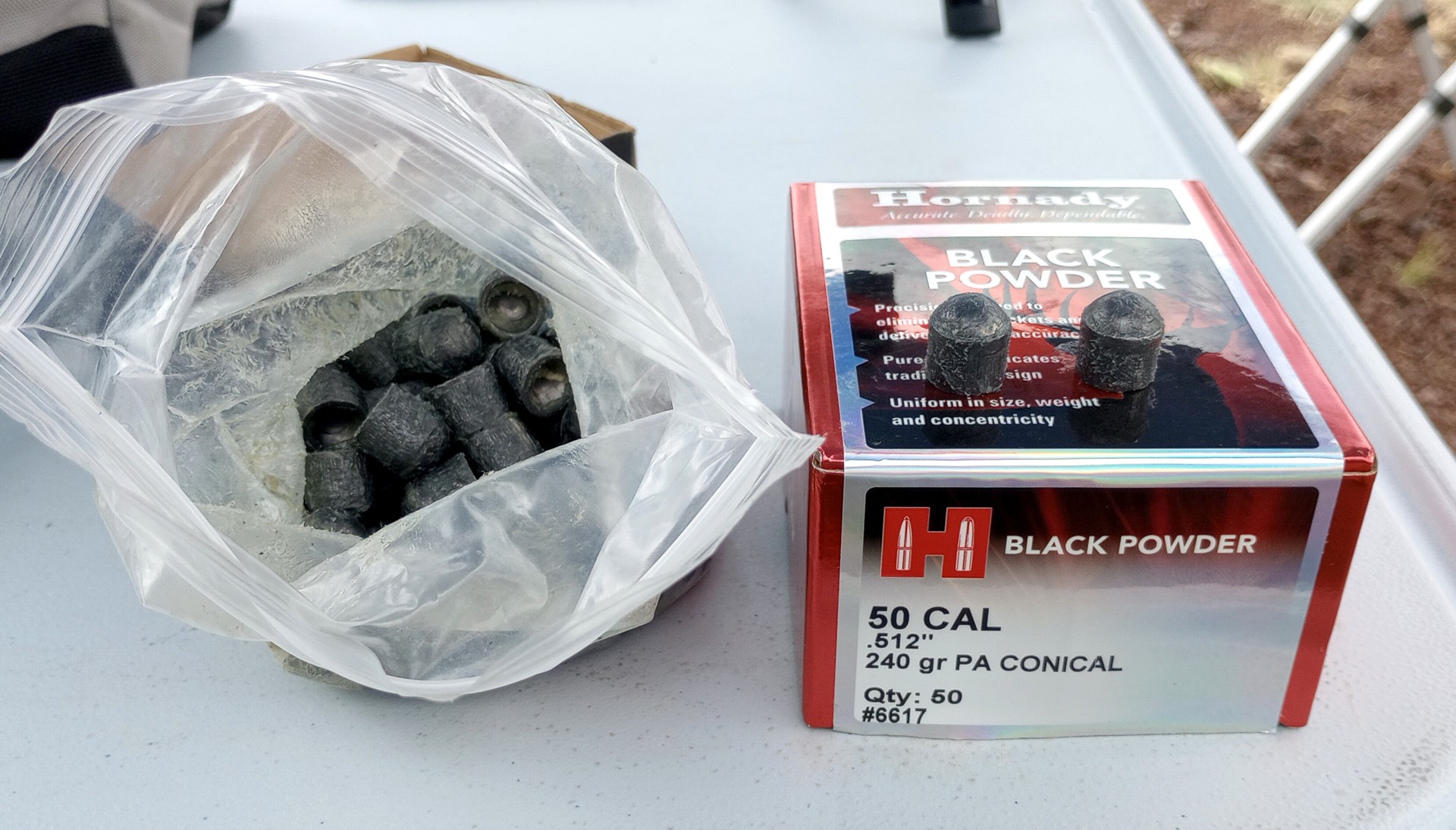
The Hornady PA Conical comes packed in a 50-count box. Inside the box is a ziplock
plastic baggy, inside of which all the bullets are packed. The bullets come inside the
baggy because they are pre-lubed and are very gooey to handle. I keep a paper towel
inside the box so that I can wipe off my fingertips after handling the bullets.
The base of the bullets are slightly undersize, so they start into the bore very easily.
There is a full-bore-size driving band near the top that engages the rifling as you push
the bullet further down the muzzle. Once the driving band is engraved by the rifling,
pushing the bullet all the way down is very easy. Like a Minié ball, the base is concave,
though not deeply hollow like a true Minié. The bullet obturates to fully engage the
rifling when the charge ignites.
Here are the shooting results:
No shoulder-busters here. Kinetic energy for the PA Conical load is 966 ft-lbs, and for
the round ball, it is 905 ft-lbs. Accuracy with both projectiles is on-par with the White
Mountain Carbine’s best javelina hunting load. Right now the PA Hunter Carbine is zeroed
for the PA Conical, even though the average group during this test was slightly larger.
I think the Pennsylvania Hunter Carbine has become my favorite iron-sight T/C muzzleloader.
That’s due to how easy-carrying it is, and because it’s fun and cheap to shoot. Even the
PA Conicals are reasonably priced.
The application period for the spring 2026 javelina season is almost here. When the
season rolls around, it will be interesting to see which son chooses which muzzleloader
to hunt with. I’ll let them make their choices first, then I’ll make my choice from
what’s left over.